
Video (preview)
SEVENTH HEAVEN? (some text hidden) --NONE--
By Jonathan Crouch
The BMW 7 Series re-invents itself once again. Jonathan Crouch takes a look.
Ten Second Reviewword count: 63
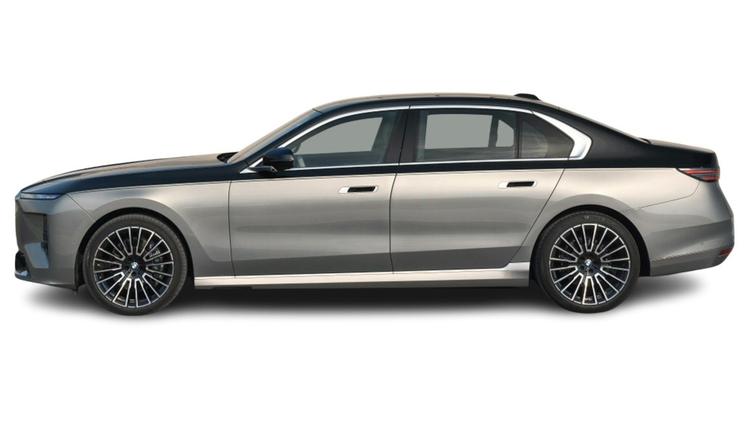
BMW revitalised its large boardroom-level 7 Series saloon when it launched the seventh generation G70-era version back in 2022. And claims to have almost reinvented it again with this updated model, announced four years into production. It represents the most extensive facelift in the brand's history. And it's very luxurious indeed. But you're still going to have to like the way it looks.
Backgroundword count: 149
The BMW 7 Series has been with us for over half a century and it's always been a showcase for the Munich maker's latest technology. The seventh generation version added a divisive brand of pavement presence to its CV at launch back in 2022, which some boardroom buyers liked and some didn't. As before, the PHEV and i7 versions of this car are this Munich maker's direct alternative to the Mercedes S-Class and EQS. Both those Stuttgart models have been updated in recent times, though arguably not as extensively as this 7 Series has been. The 7 now has a slightly smarter look and a completely new dashboard. Even more significantly, the i7 version is no longer quite as far off the drive range and DC charging figures of a rival Mercedes EQS thanks to a larger all-new battery. Will it all be enough? Let the boardroom battle commence.
Engines and Tech Specword count: 350
As before, there are two distinct kinds of G70-era 7 Series, one with a PHEV combustion unit, the other the full-EV i7. It's the i7 that gets the lion's share of the engineering updates here, including a new 112.5kWh battery (up from 105.7kWh) which has the same new-era 'Gen6' cylindrical cells as those in the new i3. This, along with the adoption of the i3/iX3 models' more efficient electrically-excited synchronous motors, has massively boosted drive range. That's now up to 452 miles for the entry-level i7 50 xDrive (up from 387 miles before), which has 455hp from its dual motor drivetrain, with 0-62mph taking 5.5s. Many customers will want a more powerful i7 than that. The mid-level i7 60 xDrive (as before) offers 544hp, with 0-62mph taking 4.8s and 451 miles of range. Beyond that is the top i7 M70 xDrive, which has 680hp (with 1,015Nm of torque!) and 426 miles of range. Because this i7 is still based on a combustion-based platform (BMW's CLAR architecture), these range figures continue to lag some way behind those of the comparable more bespoke EV-engineered rival Mercedes EQS. The PHEV variants have also been refreshed, though not quite as extensively. Their straight-six petrol engine is now BMW's updated unit and features a new turbocharger. The base 750e has 489hp, makes 62mph from rest in 4.8s. Now more powerful is the PHEV alternative, the M760e xDrive, which now has 40hp extra, so a total of 612hp (and 800Nm of torque), taking the car to 62mph in 4.2s. In both cases, the 18.7kWh 'Gen5' battery is as before, giving an EV range of about 50 miles. As you'd expect, all version of this G70-era 7 Series continue to be engineered primarily for either motorways or the metropolis. But secondary roads are also tackled in its stride thanks to adaptive self-levelling air suspension, which lowers itself by 10mm in 'Sport' mode (and at speeds of over 75mph) to improve stability. You can also use it to raise the ride height by 20mm to avoid damage on rougher sections of road. Active rear steering is also standard.
To see the full road test text contact us on 0330 0020 227
Pictures (high res disabled)
.jpeg)
|
.jpeg)
|
Statistics (subset of data only)
Min |
Max |
|
Price: |
£105,000.00 (At 15 May 2026, est) |
£120,000.00 (At 15 May 2026, est) |
Insurance group 1-50: |
50 |
|
Max Speed (mph): |
130 (i7 xDrive 50) |
155 (i7 xDrive 50) |
0-62 mph (s): |
5.5 (i7 xDrive 50) |
3.8 (i7 M70 xDrive) |
Length (mm): |
5395 |
|
Width (mm): |
1950 |
|
Height (mm): |
1550 |
|
Boot Capacity (l): |
500 |
525 |