
Video (preview)
FIVE LIVE (some text hidden) --NONE--
By Jonathan Crouch
Audi's RS 5 becomes more practical, powerful and electrical. But very desirable at the same time. Jonathan Crouch takes a look.
Ten Second Reviewword count: 44
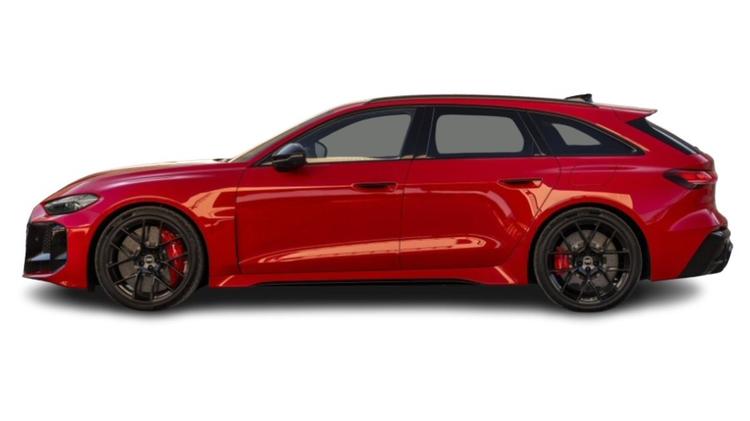
The first Audi RS 5 not to be a coupe is the first one to truly fulfil the handling promise of its RS badge. That this family five-door does this despite carrying the hefty weight of a PHEV drivetrain makes it even more impressive.
Backgroundword count: 196
Building a practical mid-sized high performance car isn't as easy as it used to be. The days of big capacity high-revving engines are behind us but a lot of customers aren't yet quite ready for an EV. The PHEV alternative that leaves carries the huge downside of weight and despite adding huge power to offset that, recent Plug-in Hybrid performance products like the Mercedes-AMG C 63 and the current BMW M5 haven't been universally well received. Perhaps Audi will do better with this, their performance Plug-in Hybrid, the RS 5. This is the third generation of RS 5 and the third time this model line has changed engines. The first two models were coupes, the original in 2011 with a 4.2-litre V8 and its replacement in 2017 with a 2.9-litre V6. The MK3, announced in early 2026, isn't really a MK3 because it isn't a coupe, the switch to 'saloon' (actually a hatch) and Avant estate body styles making it actually a more direct replacement for the brand's B9-generation RS 4. But what matters here isn't the naming convention. It's whether this car can overcome its prodigious 2.5-tonne kerb weight and be a genuine driver's car.
Engines and Tech Specword count: 579
This is the Audi Sport division's very first Plug-in Hybrid, made possible by this third generation RS 5's 'Premium Platform Combustion' architecture. The basic drivetrain - a 2.9-litre six cylinder unit linked to an 8-speed auto - seems familiar from the B9-generation RS 5 Coupe. But around 60% of the pieces from that previous car's powerplant are now different (as is the 510PS output). And that's before you take account of the 130kW electric motor now linked to it that boosts total output to 639PS (around 50% more than that old model). And generates a devastating 825Nm of torque. More power also, if you're wondering, than the recently-departed C8-generation RS 6. But of course all of this is needed given that in the 2,370kg Avant form most will choose, this RS 5 is around half a tonne heavier than the B9-era RS 4 it effectively replaces. Not that you'd guess that from a 0-62mph time of just 3.6s that pins you back into your seat. Add the optional speed upgrade and it'll keep going to 177mph. That's one way of driving this car. The other extreme is simply to rely on the PHEV drivetrain's large 22kWh battery, said to be capable of taking you up to 50 miles on a charge and at speeds of up to 87mph. Ideal for fossil-free emission daily errands. Where you might expect this whole complicated heavy confection to fall apart is at speed through the turns; it doesn't. Power goes to all four wheels and through these curves, the car makes use of a limited-slip differential that can split that power anywhere between 70/30 to 15/85 front-to-rear. What really makes it feel so surprisingly agile though is Audi's new Dynamic Torque Control system, which Audi Sport says is 'the invisible maestro' to this RS 5's dynamics. This shifts torque between the rear wheels when cornering at speed, though does so very differently to the old mechanical system that did this job on older RS5 and RS 4 models. This set-up is electric (using an 8kW motor), so reacts much quicker, able to shift up to 2,000Nm of torque to each wheel, theoretically allowing for 'insane' cornering speeds. With simply astounding levels of quattro traction. For those times, say on a track, when you might not want ultimate levels of grip, there's also a 'drift' setting - Audi calls it the 'RS Torque Rear' mode - which allows you to slide the car about and burn up the expensive bespoke rubber (Bridgestone Potenza Sport or Pirelli P Zero R). With this, there's even a graphic on the infotainment screen that can measure the angle of your slides and rank the best ones. For track use, you'll want to spend more on the optional carbon ceramic brakes (440mm-diameter front discs and 420mm rear discs). When you're not hooning about on a track in your RS 5, you'll be surprised by how supple the ride is in regular use, set in the 'comfort' drive mode. There's no air suspension - just adaptive twin-valve dampers with four stages of adjustment. And the anti-roll bars are passive - with no four-wheel steering system either. The steering's more direct of course than a normal A5 or S5 - the ratio set at 13:1 (down from 15:1). Plus the wheel widths are different front-to-rear on an RS 5 and the tyre sidewalls are much stiffer. Best of all, there's a violent roar under harsh acceleration in the fiercest drive settings.
To see the full road test text contact us on 0330 0020 227
Pictures (high res disabled)
.jpeg)
|
.jpeg)
|
Statistics (subset of data only)
Min |
Max |
|
Price: |
£89,400.00 (At 28 May 2026, Saloon) |
£109,385.00 (At 28 May 2026, Avant performance vorsprung) |
Insurance group 1-50: |
50 |
|
CO2 (g/km): |
86 |
102 |
Max Speed (mph): |
177 |
|
0-62 mph (s): |
3.6 |
|
Length (mm): |
4897 |
|
Width (mm): |
1953 |
|
Height (mm): |
1445 |
|
Boot Capacity (l): |
361 |
|