
Video (preview)
HI AMBITIONS (some text hidden) SECTIONED_new_toyotahilux_2026
By Jonathan Crouch
The ninth generation version of Toyota's indestructible Hilux pick-up takes a further step into the electric era. Jonathan Crouch drives it.
Ten Second Reviewword count: 49
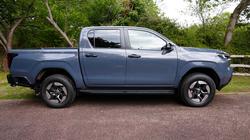
At first glance, everything seems different about the ninth generation Toyota Hilux pick-up - more angular looks, an all-new cabin and the new alternative of full-EV version. Under the surface though, it retains all the rough tough usability that's always made it the expert's choice in the pick-up segment.
Backgroundword count: 207
Think of a pick-up and it's quite likely that you'll be picturing a Toyota Hilux. This model has, after all, been a dominant presence in the global pick-up market for around half a century. Here's the ninth generation version. Quite a lot's different here to suit the current electrified zeitgeist. Headline news is that there's now a full-EV version. The 2.8-litre diesel model though, will continue to be the core seller, now standardised with a 48V mild hybrid system. Toyota says there will be a hydrogen fuel cell version too later in production. The Hilux sells in 172 countries around the world and has sold in the UK since 1972. Since then, it's earned a reputation for class leading toughness. This, after all, was the vehicle Jeremy Clarkson and Top Gear drowned, threw from the top of a tower block and still drove home. It was the first vehicle to be driven to both North and South Poles. It's conquered the Antarctic, the slopes of live volcanoes and the gruelling Paris-Dakar rally. It is, in short, for everyone from suburban builders to Libyan freedom fighters, a pick-up trusted the world over to get the job done. So what of this MK9 model? Let's take a closer look.
Driving Experienceword count: 434
The two powertrains on offer this time round could hardly be more different and will be chosen by completely different kinds of customers. Toyota had to do a full-EV model this time round (we'll get to that) but for the time being, the vast majority of sales will still be taken by the diesel. Indeed, you'll have to choose the diesel unless you're happy to compromise very heavily on towing capacity and payload. The engine in question is the 2.8D unit that featured in this pick-up before, embellished by a 48V mild hybrid system. That Hybrid set-up is based around three principal components: an electric motor generator, which replaces the conventional alternator; a 48V lithium-ion battery; and the DC-DC converter which controls the energy flow battery and motor. This electrified powerplant is paired to an eight-speed auto gearbox and in no way affects off-road ability. The stats are much the same as before, so this 4WD 201bhp powertrain has 500Nm of torque and will tow up to 3,500kg. The diesel's specially designed starter generator is mounted up high in the engine bay to preserve the 700mm wading figure. As mentioned, the alternative is the Hilux BEV. To create permanent 4WD, this has two electric motors - one on each axle - together generating 193bhp. The battery that energises these has to fit within the confines of the chassis rails - which is significant because it means that it can't be very big, rated at just 59.2kWh. Which in turn means that range is restricted to just 150 miles. It might also bother long-time Hilux owners to learn that like all MK9 versions of this design, electric power steering has been at last been adopted. And, even more significantly, unlike the diesel, the EV has no differential locks or anything like a low-range gearbox. Instead, there's a Multi-Terrain Select system to control motor output. You just pick the mode you need for the ground you're covering, whether it's sand, mud, rocks, dirt roads or moguls. Or leave the system in auto to manage throttle, steering and the AWD system by itself. The BEV matches the Hilux diesel when it comes to approach and departure angles (which are 29 and 24-degrees respectively). It has the same 700mm wading depth, 500mm of wheel articulation and 207mm of ground clearance, but the breakover angle is 4-degrees shallower than the diesel, at 20-degrees. On the highway in the BEV, 0-62mph takes under 10s on the way to just 87mph. Mid-range pulling power though is strong, with 206Nm of torque developed by the front motor and 269Nm at the rear.
To see the full road test text contact us on 0330 0020 227
Pictures (high res disabled)
.jpg)
.jpg)
|
.jpg)
|
.jpg)
| |||
.jpg)
|
.jpg)
|
.jpg)
| |||
.jpg)
|
.jpg)
|
|
Statistics (subset of data only)
Min |
Max |
|
Price: |
£42,845.00 (At 9 Sep 2026, Diesel 48V Active inc. VAT) |
£55,695.00 (At 9 Sep 2026, All-electric Invincible inc. VAT after PiVG) |
CO2 (g/km): |
254 (diesel) |
|
Max Speed (mph): |
87 (BEV) |
109 (diesel) |
0-62 mph (s): |
10.7 (diesel) |
9 (BEV) |
Electric WLTP-Rated Driving Range (miles): |
159 |
|
Combined Mpg: |
29.1 (diesel) |
|
Length (mm): |
5320 |
|
Width (mm): |
1855 |
|
Height (mm): |
1865 |
|
... and 2 other stats available | ||
Scoring (subset of scores)
Category: Pick-Ups
| Performance | |
| Handling | |
| Comfort | |
| Space | |
| Styling, Build, Value, Equipment, Depreciation, Handling, Insurance and Total scores are available with our full data feed. | |