
FAMILY FRIENDLY WITH PRIMARK PRICING (some text hidden) --NONE--
By Jonathan Crouch
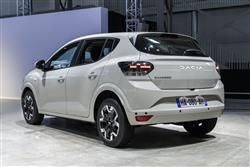
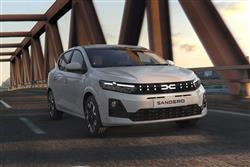
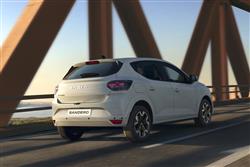
This enhanced version of the third generation Dacia Sandero could very well completely change the way you think about budgeting for a new compact family car. Jonathan Crouch reports.
Ten Second Reviewword count: 91
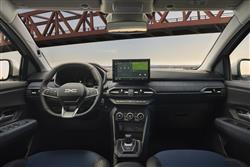
Wouldn't it be good if the Dacia Sandero could feel properly modern as well as being properly cheap. Well, we're promised that this improved version of the MK3 design is exactly that. Really modern that is. It still pretty cheap too - still the cheapest family car you could choose - but at the same time as being a far better quality hatch in this rejuvenated form. If you're just about to buy a mainstream brand city car, supermini or family hatch, you need to stop right here and read on....
Backgroundword count: 215
From Renault's point of view, it was a great concept. Buy a struggling Romanian car brand (in 2004) using factories with cheap labour. Then take a last-generation Renault hatch design, freshen it up with modern styling and a different badge and sell it at the kind of super-cheap prices that all of these short-cuts could facilitate. So was born the Dacia Sandero in 2013, which was then - and still is now - by some margin Britain's most affordable compact family hatch. With the original version we got here (which was actually a second generation design and got a lightly freshened update in 2017), you very much got what you didn't pay for, but loyal owners didn't care. Some of us though, wondered whether this car's sales prospects wouldn't be considerably improved if just a fraction of that affordability could be sacrificed in favour of creating more modern, efficient engineering. In a cabin that didn't feel quite so much like a Bulgarian thrift store. A step towards that goal was made with the third generation model launched in 2020. And continued progress has been made by that MK3 model in the updated form launched in 2025. This model gained a hybrid 155 drivetrain late in 2026. Bringing us to the Sandero we look at here.
Driving Experienceword count: 323
Sandero owners will continue to primarily choose this car with a 1.0-litre three cylinder petrol TCe engine, producing either 100hp in the standard Sandero - or 110hp in the Sandero Stepway. This core powerplant has that slightly off-beat feel that's unique to three-cylinder engines. And remains paired to the same 6-speed manual gearbox. This has a supremely light shift action, though can feel slightly rubbery and imprecise when you click the gears into each ratio. The altermative to that unit is the far more advanced and frugal hybrid 155 petrol powertrain. This combines a 109hp 1.8-litre four cylinder petrol engine, two electric motors (a 50hp motor and a high-voltage starter/generator), a 1.4kWh battery (230V) and an automatic electric gearbox with four gears for the ICE engine and two others for the electric motor. The hybrid's clever clutchless transmission uses four gears for the petrol engine and two for electric operation, automatically choosing between the different combinations of petrol and electric power. Both Sandero and Sandero Stepway hybrid 155 accelerate from 0-62mph in 8.3 seconds, while the instant response of the electric motor makes for smooth and easy progress whether threading through town or heading further afield. Regenerative braking recovers energy when slowing down and feeds it back into the battery, so there's no need for the driver to think about when or how to recharge it. Otherwise, all is as before, so the Sandero continues to ride on the same Renault Clio-derived CMF-B platform. The electric steering remains light and still doesn't offer any meaningful feedback, but it's precise and predictable enough for everyday driving, and the turning circle is usefully tight at 10.5 metres. You'll get a bit of extra wheel travel if you opt for the crossover-style Sandero Stepway model, but nothing else in terms of off road SUV engineering. So it'll be fine for school run kerbs but of course no use at all for any real off road shenanigans.
To see the full road test text contact us on 0330 0020 227
Pictures (high res disabled)
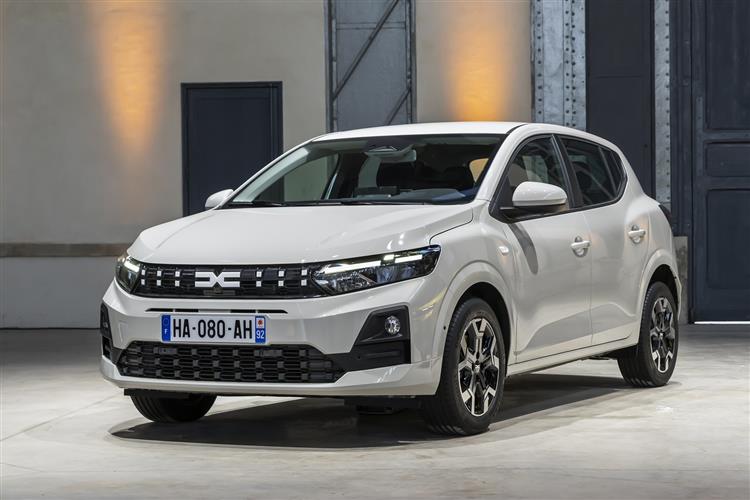
|
|
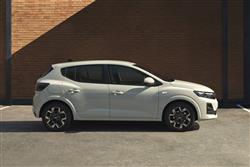
| |||
|
|
| |||
|
Statistics (subset of data only)
Min |
Max |
|
Price: |
£14,765.00 (Estimated At 16 Nov 2026, Essential TCe 100) |
£19,295.00 (Estimated At 16 Nov 2026, Journey hybrid 155) |
Insurance group 1-50: |
10 |
|
CO2 (g/km): |
121 (TCe 100) |
100 (hybrid 155) |
Max Speed (mph): |
111 (TCe 100) |
112 (hybrid 155) |
0-62 mph (s): |
9.7 (TCe 100) |
8.3 (hybrid 155) |
Combined Mpg: |
53.3 (TCe 100) |
64.2 (hybrid 155) |
Length (mm): |
4102 |
|
Width (mm): |
1848 |
|
Height (mm): |
1499 |
|
... and 2 other stats available | ||
Scoring (subset of scores)
Category: Small Runabouts
| Performance | |
| Handling | |
| Comfort | |
| Space | |
| Styling, Build, Value, Equipment, Depreciation, Handling, Insurance and Total scores are available with our full data feed. | |