
NO LONGER PEPPER PIG (some text hidden) --NONE--
By Jonathan Crouch
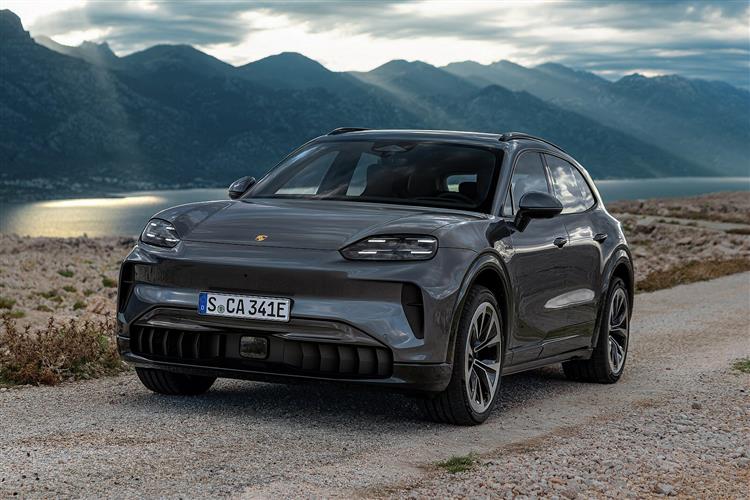
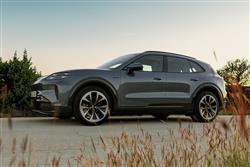
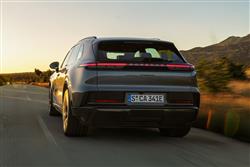
Porsche's Cayenne Electric is a large sporting SUV that's an astonishing feat of technology. Jonathan Crouch drives it.
Ten Second Reviewword count: 52
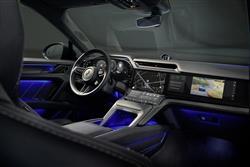
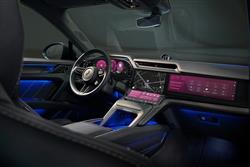
Porsche's Cayenne Electric is a completely different kind of Cayenne - and not only because it's battery-powered. It's sleeker, more technically advanced and has a fresh generation of interior design. In top Turbo form, it's faster too. Here, Zuffenhausen has reset the standard for what a large, sporting luxury SUV should be.
Backgroundword count: 168
Back in 2002, the Porsche brand was changed forever by a big, bold SUV called the Cayenne. And a quarter of a century on, here's another model of that name, the Cayenne Electric, that might have almost as much impact. In original concept, it was meant to be even more important than that; it wasn't very long ago that Porsche was boasting that 80% of its line-up would be full-electric by 2030. But those unrealistic ambitions have been scaled down radically, as proof of which updated versions of the existing combustion Cayenne will continue to be sold well into the next decade. The Cayenne Electric shares nothing but its name with that car. It rides on a completely different PPE platform (shared with the Macan Electric) which allows it to be significantly bigger. Plus it sets new standards for EVs in terms of towing weight and the introduction of an inductive charging system that doesn't require you to physically plug the car in. Let's take a closer look.
Driving Experienceword count: 547
Most Cayenne Electrics will come with the dual motor AWD powertrain we tried, which develops 442PS in the standard model or 666PS in the pricier Cayenne S Electric. If that should somehow be insufficient, then there's also the top Cayenne Turbo Electric, which fronts up with an astonishing 1156PS. And that's not even the highest output in its segment. Back in the real world, at the base of the line-up, as with the Macan Electric, you can ask your dealer about a single motor rear-driven model, which wasn't being offered at the time of this test. If you're a potential customer, you'll be pleased to hear that all models get dual-chamber air suspension with the dual-valve adaptive dampers of the Porsche Active Suspension Management system. It doesn't float you about like such a set-up might on other rival premium brand German models, but that wouldn't be very Porsche-like and there's a nice balance achieved here between removing road surface harshness without also removing the connection you need to feel with the road surface in a Zuffenhauasen-badged model, aided by superbly precise steering. Refinement is also excellent, though only class-leading if you shell out extra for optional double-glazed glass. And there are smoothly consistent brakes that juggle friction and regen stopping impressively well. You might be expecting a bit more in terms of performance, given that the asking price of the mainstream 442PS Cayenne Electric would get you 146PS more in a rival BMW iX5 60xDrive, though hobbled by bulk that's even heavier than this Porsche's 2.7-tonne kerb weight, that competing Munich model only betters the base dual motor Cayenne Electric's 4.8s 0-62mph sprint time by a mere 0.2s and this Porsche EV's surprisingly high 143mph top speed is actually 13mph higher than an iX5. We should point out that the total output figures we've quoted for the three twin motor Cayenne Electric models only apply during a Launch Control-enabled start or during the activation of a 10-second 'Push-to-Pass' 'overboost' feature intended for quick overtaking and enabled by pushing the centre of the steering wheel-mounted drive mode controller. The Launch Control 62mph sprint time is reduced to 3.8s in the Cayenne S Electric and a scant 2.5s in the Cayenne Turbo Electric, the latter capable of up to 162mph. When it comes to brake regen, the brand doesn't seem to believe in either steering wheel paddles or 'one-pedal' driving; if you want regen on, the screen-selectable 'Recuperation' feature offers only 'on' and 'auto' options, neither of which are very fierce. Which isn't going to help when it comes to trying to extend the range of the 113kWh battery all dual motor Cayenne Electrics have to have. That might seem quite large, but it's actually substantially smaller than the powerpack of that rival BMW iX5, which is a massive 141kWh in size (explaining why that Munich model will take you so much further on a charge); whereas this dual motor Cayenne Electric is supposed to achieve up to 395 miles on a charge, it'd be up to 525 miles in that iX5 - so probably another couple of hours of driving. Curiously, the faster Cayenne S Electric goes fractionally further than the lesser version - up to 403 miles, while the Cayenne Turbo Electric manages up to 384 miles.
To see the full road test text contact us on 0330 0020 227
Pictures (high res disabled)
|
|
| |||
|
|
| |||
|
|
|
Statistics (subset of data only)
Min |
Max |
|
Price: |
£83,200.00 (At 20 Nov 2026, Cayenne Electric SUV) |
£130,900.00 (At 20 Nov 2026, Cayenne Turbo Coupe Electric) |
Insurance group 1-50: |
50 |
|
Max Speed (mph): |
143 (Cayenne 4 Electric) |
|
0-62 mph (s): |
4.8 (Cayenne 4 Electric) |
|
Electric WLTP-Rated Driving Range (miles): |
395 |
|
Length (mm): |
4985 |
|
Width (mm): |
2199 |
|
Height (mm): |
1674 |
|
Boot Capacity (l): |
534 |
781 |
Power (ps): |
442 (Cayenne 4) |
1156 (Turbo) |
Scoring (subset of scores)
Category: Hybrid, Plug-in, Electric & Hydrogen
| Performance | |
| Handling | |
| Comfort | |
| Space | |
| Styling, Build, Value, Equipment, Depreciation, Handling, Insurance and Total scores are available with our full data feed. | |