
THE SMART UTILITY VEHICLE (some text hidden) --NONE--
By Jonathan Crouch
Jonathan Crouch reports on the further improved version of Volvo's second generation XC60 mid-sized SUV.
Ten Second Reviewword count: 98
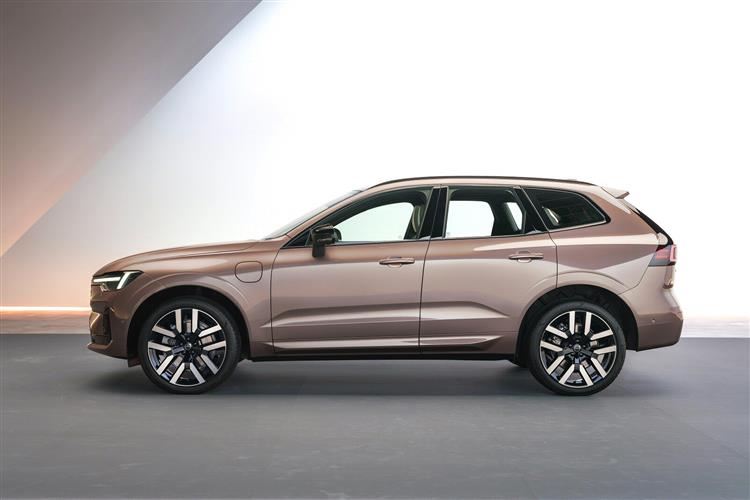
Think of a premium-badged mid-sized SUV and you probably think of something German -maybe also a Land Rover or Lexus product. We'd also suggest though, that you should be looking at the car we're going to test here, the further improved version of Volvo's elegant and beautifully crafted second generation XC60, now featuring a fresh look inside and out. And a dramatically improved PHEV drivetrain. It's proof that in Sweden, they build SUVs just a little differently. Safe, efficient, clever, practical and stylish, it's yet another model that re-establishes this Scandinavian maker as a credibly prestigious automotive brand.
Backgroundword count: 235
Market indecision about EVs has prolonged the life of this car, the second generation version of Volvo's mid-sized premium SUV, the XC60. This MK2 model was first introduced back in 2017 (replacing an extremely successful predecessor originally launched in 2008). Then facelifted first in 2021. By 2025, the company should have been easing this combustion model out of the showrooms to make way for the all-electric EX60. Instead, this XC60 got a stay of execution - and a second facelift. Followed for the 2027 by the further update we look at here. Once, Volvo was a car maker primarily specialising in spacious estates and solid, safe saloons. It isn't true any more. The brand now builds fewer cars of that sort and today, the majority of its business is done in selling SUVs - cars like this XC60. So successful has the XC60 model line been that in 2025, it surpassed the brand's iconic Volvo 240 to become the best-selling Volvo model ever, with over 2.7 million examples sold. Today, it's still built at Torslanda in Sweden and Chengdu in China. And continues to use the 2.0-litre 'Drive-E' engines and 'SPA' 'Scalable Product Architecture' platform that Chinese brand owner Geely bankrolled as part of its brand takeover in 2010 for all ongoing mid and large-sized Volvo models to use. But much has changed about this car in recent times - as we're about to see.
Engines and Tech Specword count: 410
Not much was done to the engineering of this second generation XC60 as part of the 2025 update; now we know why. The Swedish engineers were working on a class-leading step forward in this regard - or at least that's what you get from one of the two powertrains on offer anyway. The most affordable B5 mild hybrid petrol unit, Volvo's long-running 'Drive-E' 2.0-litre turbo four cylinder engine, putting out 250hp and embellished with 48V mild hybrid tech, hasn't been changed at all. All the effort's gone into the Plug-in Hybrid powertrain, which gains a massive increase in battery size - from 18.8kWh to 41.2kWh (37.9kWh usable). This facilitates an equally enormous increase in EV drive range - from 50 miles to a class-leading 124 miles. That's double what you get from most rivals, even all-new versions of the BMW X5 and Audi Q7. As before, the huge battery feeds a rear electric motor, which is now more powerful (up from 145 to 175hp) working in tandem with the same 2.0-litre turbocharged four cylinder engine this model's always had. As previously, there are two XC60 PHEV models, each now badged 'long-range PHEV'; the T6, with 350hp and the T8 with 455hp. Expect similar performance figures to before, which means 0-62mph in 5.7s in the T6 and 4.9s with the T8, en route to the 112mph top speed that all Volvos share. Nothing's been done to the drive dynamics, which were tweaked slightly as part of the 2025 facelift, when Volvo softened up the passive dampers and worked on refinement. So drive dynamics continue to be based towards comfort. But you shouldn't gauge from that an expectation that this XC60 will be a complete duffer when the road turns twisty. It's very far from that, this model described as 'confident and predictable', which is precisely what most likely buyers will want it to be. There's unruffled poise and exemplary refinement, plus you get supple standards of ride comfort from the multi-link rear suspension and top variants continue to have the desirable 'Active Four-C' adaptive damping and air suspension package. A 'Drive Mode Settings' driving dynamics system allows you to tailor throttle response, steering feel and shift timings from the standard 8-speed auto gearbox to suit the way you want to drive. If you do decide to push on a bit, grip and traction are actually quite impressive aided by the AWD system, while cornering body roll is also decently well controlled.
To see the full road test text contact us on 0330 0020 227
Pictures (high res disabled)
.jpg)
|
.jpg)
|
.jpg)
| |||
.jpg)
|
.jpg)
|
.jpg)
| |||
.jpg)
|
.jpg)
|
.jpg)
| |||
.jpg)
|
.jpg)
|
.jpg)
| |||
|
Statistics (subset of data only)
Min |
Max |
|
Price: |
£50,000.00 (At 25 Sep 2026, est) |
£75,000.00 (At 25 Sep 2026, est) |
Insurance group 1-50: |
34 |
41 |
CO2 (g/km): |
22 (PHEV) |
23 (PHEV) |
Max Speed (mph): |
112 (T6) |
|
0-62 mph (s): |
5.7 (T6) |
|
Electric WLTP-Rated Driving Range (miles): |
124 |
|
Combined Mpg: |
36.6 (B5) |
|
Length (mm): |
4708 |
|
Width (mm): |
1999 |
|
... and 3 other stats available | ||