AN S THAT STILL IMPRESSED (some text hidden) --NONE--
By Jonathan Crouch
Introductionword count: 73
Tesla's Model S was the brand's original EV, an electric large luxury fastback with around 400 miles of range. In 2023 it got its final package of improvements, becoming sleeker and more sophisticated and offering almost supercar-style acceleration. Plus the car was updated with a completely new interior and there was a choice of either 'Dual Motor' or 'Plaid' AWD variants with 100kWh battery outputs. Let's check it out as a used buy.
Modelsword count: 6
5dr Fastback (EV) [Dual Motor, plaid]
Historyword count: 489
Would it be too much to call Tesla's Model S a 'game changer'? We don't think so. Back in 2012, this car launched what is now the world's best known automotive EV brand on an unsuspecting world. It shocked the established brands into getting on with the electric era. And it was a luxury executive EV benchmark that others aspired to for nearly a decade, originally engineered with a goal of creating the best car in the world. You'd think though, that after well over ten years on sale, it'd be time for a completely new design to face a flood of fresh rivals. Instead, what we got in 2023 was this heavily revised version of the original. This wasn't the first Model S update - the earlier one happened in 2016 when the car lost the original version's fake grille. But the 2023 update (after the car had been off sale in the UK for two years) was by far the most significant change to this Tesla - as was needed after a decade on sale and with several hundred thousand examples pounding global roads: not that you'd know that from the remarkably subtle exterior differences between this post-2023-era car and the original. Still, Tesla fitted a completely redesigned cabin; the body structure was different, the suspension was re-engineered and the complicated confusing range of single motor versions was dropped, with the Dual Motor variants that remained using a larger and completely different 100kWh battery pack. For UK customers though, all this excellent development work was sabotaged by this US brand's confusing decision to restrict imports here to left hand drive models only, with the same directive also applied to improved versions of this car's SUV Model X stablemate. Right hand drive Model S production was suspended in 2020 and never re-started. You're really going to have to want this Tesla to put up with that: but you might. For a start, even in its standard Dual Motor form, it's frantically fast, with the top tri-motor Plaid version going further, claiming at launch to be the fastest-accelerating production car in the world. If you thought the million pound Bugatti Veyron held that title from this period, think again; actually in this car's lifetime only the vastly more expensive Porsche Taycan Turbo GT got close. Yet this is achieved while operating in a level of silence that'll make a Rolls Royce seem hopelessly unrefined. But then the Model S has always been a car that thinks way beyond the box. So does Elon Musk, Tesla brand co-creator and co-founder of a Pay Pal organisation that's given him such reserves of operating capital that he could afford to spend as much as was necessary on the original design for this car. If you think you've seen everything in automotive terms, well you haven't. Not until you've tried a Model S anyway. The car was finally taken off sale in 2025.
What You Getword count: 960
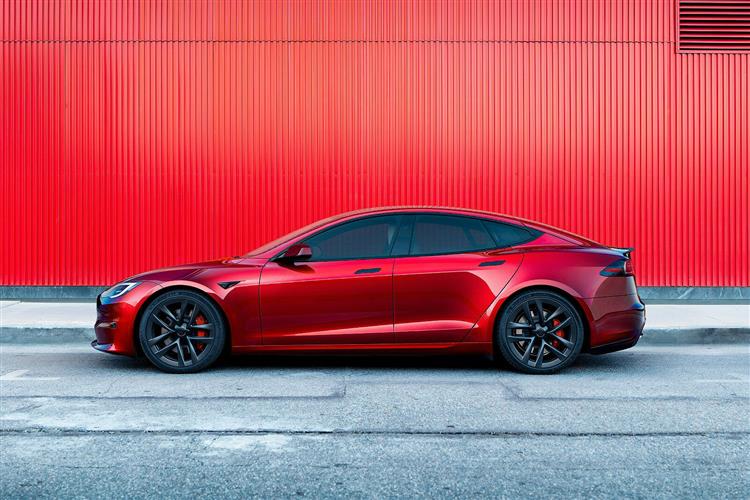
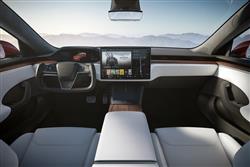
Despite all the changes that went on under the skin, at first glance Tesla's kept its 2023 Model Year Model S visual updates to a minimum. From the side, the updates were subtle, though an original owner would appreciate the more muscular proportions, especially at the rear. Wider arches give the car a squatter stance and house staggered performance wheels that keep the car planted - with 19-inch rims on the standard Dual Motor variant and big 21-inch alloys on the top Plaid version, which are wrapped in super-grippy Michelin Pilot Sport 4S rubber. The silhouette became sleeker too - Tesla claimed this to be the most aerodynamic production car on earth, with a drag coefficient of just 0.208Cd. After the very gently evolved exterior, it's something of a surprise to take a seat inside and find an interior completely that's different from that of the earlier cabin in almost every way. Not least in the way that in this post-2023-era design it makes you sit on the wrong side of the car, thanks to Tesla's refusal to build this updated car in right hand drive form. As part of this update, not a single component was shared with the original Model S, not even the huge 17-inch centre screen, which became landscape rather than portrait in format. One change you might expect that didn't happen is that there's still a separate instrument screen ahead of you; on smaller Teslas, drive instruments are confined to the near side of the central monitor. Not all Model Ss featured this redesigned cabin's real talking point, the optional aircraft-style yoke that could optionally replace the conventional steering wheel. When fitted, it gives this Model S a 'Thunderbirds'-style that suits the futuristic vibe the designers were clearly looking for. This tech-heavy look is intended to compensate you for the lack of the kind of wood, metal and stitched door and dashboard leather that you'd usually expect to find on a luxury saloon commanding a near six-figure asking price. Yes, build quality's a bit better than it used to be, the vegan leather feels quite realistic, the alcantara roof and pillar lining's lovely and there are a few strips of carbonfibre in the top Plaid version; but you don't feel spoiled in the way you should be by a car of this price. And the rough fabric on the door cards has no place in a car of this price. In true Tesla fashion, the vibe here is very minimalistic - even more so given that the brand did away with the column stalks previously provided for indicating and gear changes. Instead, the Model S guesses your intended direction of travel and requires you to confirm its prediction by tapping the brake pedal. Or you can just use a provided slider on the side of the centre screen, though that's partly obscured by the right hand side of the wheel. As for the wipers and indicators, well they're controlled with capacitive buttons on the steering tiller - the car uses its cameras and a steering angle sensor to know when to cancel the indicators. Which seems a very complicated way of fixing something that didn't really need to be fixed. We're not sure we'd bother looking for cars fitted with the optional steering yoke, but we do like the redesigned TFT instrument screen you view above it. Tesla didn't take the opportunity EV architecture offers of providing a completely flat floor under the centre screen. Instead, there's a high centre console, forward of which is an angled compartment with twin wireless charging mats. The reorientated 17-inch landscape monitor just above which used to look so vast on the Model S here no longer seems quite as huge in an era of infotainment set-ups like the enormous Mercedes Hyperscreen layout. As before, it does without a lower rotary controller, but showcases a very good Google Maps navigation system, which you can either have full-screen or part-screen, the latter moveable from side to side of the monitor via an arrow button on the far side of the display. This screen can be tilted towards either passenger and has better super-sharp graphics, though annoyingly Tesla refused to build in 'Apple CarPlay' or 'Android Auto' into it. As before, it incorporated a web browser and a Blind Spot display. In the rear the standards of head and legroom on offer are unremarkable for a car in this class, but what is impressive is this car's ability to comfortably look after three fully-sized adults. Headroom's good, even for six-footers and even with the vast panoramic glass roof fitted, which usefully lightens up the cabin and doesn't need a sun shade because it's been treated to filter out harmful rays. Not so good is the way that the rear seat squab is set quite low in relation to the floor, which doesn't deliver an ideal seating position. And cargo space? Well there's plenty of it. The lack of an engine means that the pointy end gets what Tesla calls a 'frunk' (American for 'front trunk', you see). Flip the bonnet and there's 89-litres on offer, some of the space you'd otherwise hope for compromised by the front-mounted motor. The Dual Motor or Tri-Motor drivetrains require a slight compromise in rear boot space too, but it's not hugely significant and in any case, there's plenty of room to play with. The wide-opening powered tailgate rises to reveal an enormous 793-litres of luggage space - much more than you'd get in a much pricier Mercedes EQS and sufficient to take up to 11 carry-on suitcases. There's also a decently-sized deep well beneath the floor for all the charging cables. Plus a lidded corner left compartment and a netted storage pouch on the right.
To see the full road test text contact us on 0330 0020 227
Pictures (high res disabled)
.jpg)
|
.jpg)
|
.jpg)
| |||
.jpg)
|
.jpg)
|
.jpg)
| |||
.jpg)
|
.jpg)
|
.jpg)
| |||
|
Scoring (subset of scores)
Category: Luxury Saloons and Estates
| Performance | |
| Handling | |
| Comfort | |
| Space | |
| Styling, Build, Value, Equipment, Depreciation, Handling, Insurance and Total scores are available with our full data feed. | |