
HIGH ASPIRATIONS (some text hidden) --NONE--
By Jonathan Crouch
Introductionword count: 59
Back in 2021, a mid-to-large-sized 7-seat SUV was nothing new, but one with a proper full-Hybrid engine that you didn't have to plug-in was a great deal rarer. That's what was on offer from Toyota's Highlander. Does any car in this class from the 2021-2022 period make more sense than this one? That's what we're here to find out
Modelsword count: 8
5dr SUV (2.5 petrol Hybrid) [Excel, Excel Premium]
Historyword count: 291
In a European market that back in 2021 saw manufacturers struggling to meet ever more stringent CO2 emissions regulations, what volume brand would launch a big, heavy, 7-seat large segment SUV? Probably only Toyota. And this was it: the Highlander. By this point it was clear that going forward, any large segment SUV of this kind would need to feature electrification - which in this class usually meant a plug-in PHEV powertrain. But sometimes that compromises the cabin so a third seating row can't be fitted. And usually, there are compromises in terms of efficiency because cars of this sort usually cover the kind of motorway miles that the electric range of PHEV won't be able to meet. All of which explains why a self charging full-Hybrid petrol powertrain for a car like this might well be the ideal solution if you don't want a diesel. And a full-Hybrid of this sort is something that back in 2021 few of this Highlander's direct class competitors could offer. Which is why Toyota finally decided to offer this model line here, launching in early 2021 and perfect for the SUV buyers who wanted a Toyota, required something larger than a RAV4 but didn't need the clunky capability of a Land Cruiser. By 2021, three previous generation Highlanders had sold in North American, Japanese, Russian and Australian markets, with a heritage going all the way back to the turn-of-the-century. This one though, was by far the most sophisticated, not only because of its 2.5-litre Hybrid engine but also because of the new-era GA-K platform it shared with the RAV4 and the Camry saloon. The Highlander experiment didn't really work in the UK and the car was taken off sale at the end of 2022
What You Getword count: 788
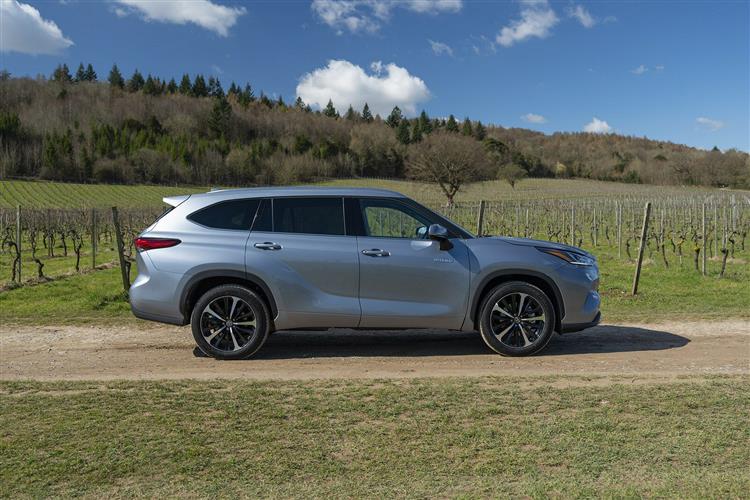
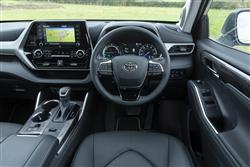
There's something of a Land Cruiser look here - but also the feel of the kind of big American SUV this Highlander is trying to be. Under the skin, its car-like monocoque construction is a cut above lumbering Stateside 4x4s but it certainly has that kind of imposing, though not especially memorable pavement presence. Especially at the front where the big, bluff trapezoidally-shaped grille dominates, it's Toyota- badged chrome strip almost an afterthought. It's just the sort of thing perfect for the parking lot at Walmart. You'll need a pretty big space though, this Highlander measuring in at only a fraction under 5-metres in length. At the rear, you get a feel for this car's substantial width (1,930mm) and height (1,755mm). As usual of course, what's more important is what you can't see, the GA-K monocoque chassis we referenced earlier. This borrows from the Toyota TNGA global architecture the brand was using at this time, which means it's a world away from the clunky body-on-frame underpinnings of a Land Cruiser. Stepping up to the driver seat has something of the feel you get with that classic global Toyota SUV though. As does the feel you get from the way you're commandingly positioned behind the wheel. Some of that's down not only to the height of your perch but the solid, durable and rather old school cabin feel. There's nothing particularly trendy in terms of design - no digital instrument binnacle screen or silly touch-sensitive controls. You don't even get the kind of big central multimedia display that at this time was just about becoming in vogue - this one is just 8-inches in size, though its rather basic graphics provide most of what you need and there's navigation and standard 'Apple CarPlay'/'Android Auto' smartphone-mirroring. Anything you can't find on here will probably feature somewhere in the instrument binnacle you view through the chunky three-spoke wheel. One of the defiantly analogue blue-needled dials, as usual on a Toyota hybrid, is a Hybrid Power Meter, to the right of which sits a 7-inch TFT multi-information screen, which you control via buttons on the left hand steering wheel spoke. What else? Well the soft, wide leather-upholstered heated and power-adjustable seats are the kind of chairs you'd want for a cruise through the Nevada desert - or more likely though the next snowy snap. There's also great all-round visibility, everything feels built to last, you get lots of cabin stowage and there are nice touches like a rear view mirror that doubles as a rearward camera; and a sliding top between the seats that eases back to reveal a wireless 'phone charging pad. Time to consider the second row. Where the big squashy seats can trundle forwards or back over a 180mm sliding range when you pull on the low corner catches, so unless you're having to compromise your position for the sake of those behind, leg room shouldn't be in short supply. Cars like this usually require a level athleticism in reaching their third seating row that'd typically be beyond granny on her Sunday afternoon trip to the garden centre, but this one's not too bad. You can enter from either side but there's a wider entrance aperture on the driver's side, accessed after a pull on the seat base catch which allows you to push the bench forward. Once in the very back, you'll be thankful for the body shape's boxy dimensions - headroom's fine, even for quite tall adults. Predictably, knee and leg room isn't - unless you've got a particularly accommodating set of passengers sat ahead of you prepared to move their chairs right forward - so as usual in a 7-seat SUV, the 3rd row is really most appropriate for those of school age. Let's finish by considering the boot, accessed via the power-operated tail gate (though it only gets a hands-free kick sensor if you stretch to top-spec trim level). This hatch creaks open at arthritic speed and finally rises to reveal a 268-litre space when all three seating rows are in place - or 332-litres if you load to the roof. Will the hybrid drive system compromise luggage capacity compared to the class norm once you start folding seats? Not really. Most of the time of course, you're going to be using this car with the third row pews folded into the floor - which gives you a 579-litre boot with the middle bench slid to its rearmost point - or 658-litres if that bench is in its mid-position. It's 865-litres if you load to the roof. Fold the centre row down as well (the seat back splits 60:40) and you can increase capacity to 1,177-litres - or 1,909-litres if you load to the roof.
To see the full road test text contact us on 0330 0020 227
Pictures (high res disabled)
.jpg)
|
.jpg)
|
.jpg)
| |||
.jpg)
|
.jpg)
|
.jpg)
| |||
.jpg)
|
.jpg)
|
|
Scoring (subset of scores)
Category: Crossover or SUV 4x4s
| Performance | |
| Handling | |
| Comfort | |
| Space | |
| Styling, Build, Value, Equipment, Depreciation, Handling, Insurance and Total scores are available with our full data feed. | |