D-LIGHT-FULL (some text hidden) --NONE--
By Jonathan Crouch
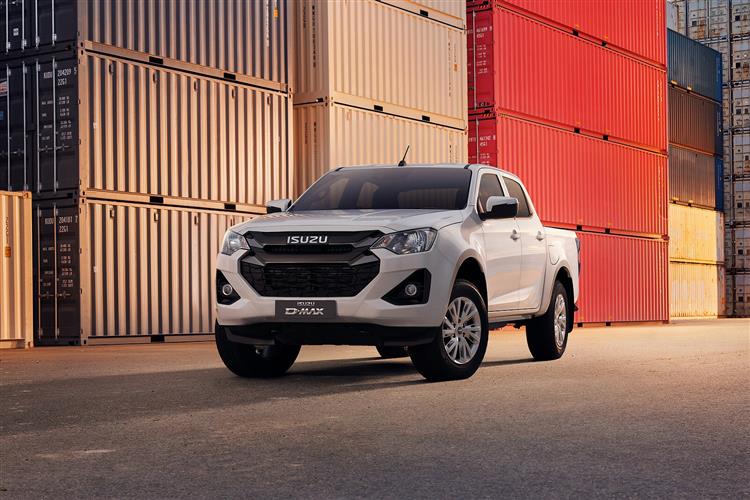
The Isuzu D-Max has now become a far more credible pick-up segment contender. Jonathan Crouch looks at the further updated version of this 'RG'-series model.
Ten Second Reviewword count: 85
Isuzu's D-Max pick-up may have been with us since 2021 in its current RG-series form, but it's evolved greatly over that time. We've had no fewer than three facelifts, the most recent delivering the lustier 2.2-litre diesel engine we consider here. An all-electric model has been added to the line-up as well. But the D-Max is still as tough as ever - which is why so many professionals choose this Isuzu. In a marketplace full of pretenders, it's that rarest of things: the genuine article.
Backgroundword count: 147
If there's one thing that's slightly held Isuzu's D-Max pick-up back a little over the last decade, it's been the fact that it's had to campaign with a slightly smaller-capacity diesel engine than its key rivals. The 1.9-litre four cylinder unit was launched in the previous generation RT-series D-Max in 2017, then carried forward into the current RG-series model at that design's original launch here in 2021. Since then, the RG-series D-Max has been updated twice but its engine has remained the same - until Spring 2026 and the introduction of a version with the diesel powertrain we look at here, now 2.2-litres in size. This update arrives just as sales of the first all-electric D-Max model begin. Most customers of this Isuzu will still want to fuel from the black pump though and they'll welcome the arrival of this torquier unit. Let's take a closer look.
Driving Experienceword count: 451
With the arrival of a larger-capacity diesel engine in the D-Max, the big change, as you'd expect, lies with increased pulling power, up from 360Nm with the old 1.9-litre four cylinder unit to 400Nm with the replacement 2.2-litre powerplant. Actual power output hasn't changed though, still rated at a modest 163PS. 0-62mph takes 12.2s en route to 112mph. As before, the engine's a turbo-charged four-cylinder unit and it features an electronically controlled fuel injection pump with intercooler and double overhead camshaft. You can still choose between either 6-speed manual or 8-speed auto transmission. There's also now a 188bhp full-EV D-Max model, using a 66.9kWh battery that offers a range of 163 miles. The 2.2-litre diesel though, is our focus here, a unit which of course retains the usual D-Max 3.5-tonne towing capacity. This relatively light powertrain (like its predecessor) enables the kerb weight of this Isuzu to dip below the government's 2,040kg weight limit that separates Goods Vehicles from passenger cars so, unlike other pick-ups in the segment, this one can be driven at passenger car speed limits. Another feature carried forward to this updated D-Max is Isuzu's useful 'Rough Terrain' drive mode. This works in conjunction with the traction control system and senses when a wheel doesn't have enough grip and is spinning faster than it should be when you're off road. The system then applies the brakes and throttle as necessary to get you moving. You're supposed to engage it before you get into a muddy situation - say at the base of a steep slippery hill. Progress through really gnarly stuff is aided by decent suspension articulation and the lockable rear differential you get on most models. Ground clearance is rated at 235mm and the fording depth at 800mm. As before, the 4WD system has capable low ratio gearing, an effective hill descent control system and a display showing what angle you're at. You can switch between two and four wheel drive on the move too, via a provided rotary dial. As for on-tarmac journeying, well the D-Max is better than it used to be in terms of cruising refinement, but it still lags behind rivals and is hardly car-like. No contender in this class can properly replicate the car-like drive dynamics of an SUV and in this one, there remains plenty of body roll at speed through tighter turns as you slide around on the flat-bottomed seats. But on the plus side, there's not too much back end floatiness when the load bay is empty and with a bit of weight in the back, it's possible at times to forget you're in a pick-up - until you lurch into a corner or clump over a speed hump.
To see the full road test text contact us on 0330 0020 227
Pictures (high res disabled)
.jpg)
|
.jpg)
|
.jpg)
| |||
.jpg)
|
.jpg)
|
.jpg)
| |||
.jpg)
|
|
Statistics (subset of data only)
Min |
Max |
|
Price: |
£33,495.00 (Estimated At 6 May 2026, Utility Single Cab ex-VAT) |
£62,495.00 (Estimated At 6 May 2026, eDL40 V-Cross - ex-VAT) |
CO2 (g/km): |
241 (AT35 auto) |
220 (manual) |
Max Speed (mph): |
112 (diesel) |
|
0-62 mph (s): |
12.2 (diesel) |
|
Electric WLTP-Rated Driving Range (miles): |
163 |
|
Combined Mpg: |
25 (AT35 auto) |
32.8 (manual) |
Length (mm): |
5280 |
|
Width (mm): |
1870 |
|
Height (mm): |
1810 |
|
... and 4 other stats available | ||
Scoring (subset of scores)
Category: Pick-Ups
| Performance | |
| Handling | |
| Comfort | |
| Space | |
| Styling, Build, Value, Equipment, Depreciation, Handling, Insurance and Total scores are available with our full data feed. | |