Volvo EX90 - ABC Leasing
SWEDE WITH A MISSION(some text hidden)
By Jonathan Crouch
Ten Second Review word count: 93
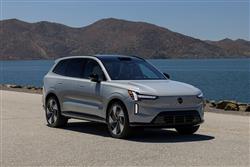
The EX90 is a large full-battery EV Crossover that has taken Volvo into a new era. As the company puts it, 'it's a statement for where we are - and where we're going', combining the brand's own engineering advances with 'the best technology from the world's best technologists'. This SUV is also one of the few large super-luxury EVs to be able to seat seven. It's an ambitious statement of intent from the Sino-Swedish brand. And now that this car has a proper 800V electrical architecture set-up, it's certainly worth a second look.
Background word count: 284
What does the future really look like for large luxury cars? Various brands have told us, but none of them are approaching that future quite like Volvo, the company proudly styling itself as 'a pioneer in the protection of people and planet'. A claim embodied most clearly in what was the first of the company's EVs to sit on a dedicated electric platform, this EX90. The original plan was for this to be the replacement for the combustion-powered XC90 large SUV model line that saved Volvo at the turn-of-the-century, though thanks to the slow pace of the EV revolution, that fossil fuelled model will now continue for several years yet. The future for flagship Volvos though, lies with EVs produced off the parent Geely Group's advanced SPA2 architecture, a platform already used by the EX90's close cousin, the Polestar 3 - and also by Volvo's similarly-sized ES90 saloon. Both cars share the same drive system and much else with this EX90, but this big Volvo SUV differs from those two other cars in its provision of three seating rows. The EX90 was first announced way back in 2023, but delay after delay meant that it didn't start filtering into UK showrooms until early 2025. In a form with an old-tech 400V electrical architecture and an older-tech Nvidia Xavier chip. We advised potential customers to wait for the properly upgraded Model Year 2026 version we're trying here, which got a much faster-charging 800V electrical system and a considerably faster Nvidia Drive AGX Orin processor. As before, the car is built for the UK at the company's US plant in Charleston - and is made at Chengdu in China too, with both plants rated carbon neutral.
Driving Experience word count: 460
There are three powertrains on offer here. Things kick off with a Single Motor rear-driven model with a 333hp motor with 480Nm of torque energised by an 92kWh battery (88kWh of which is usable) with up to 347 miles of range. Otherwise, your EX90 will be of the Twin Motor All-Wheel Drive sort we tried, with a choice of two output levels that are significantly increased over those this model was launched with back in 2021. Standard Twin Motor models offer 456hp, while 'Performance' variants up that to 680hp - incidentally a massive 170hp more than the original version. The battery of this updated post-2025-era model is slightly different too - actually slightly smaller, though it yields slightly more range. With both Twin Motor variants, that battery is now 106kWh in size (with 102kWh usable-capacity), a pack which delivers a range of up to 380 miles in the base model and up to 371 miles in the 'Performance' version. As with all Volvos, top speed is limited to 112mph. The 62mph from rest sprint takes 6.8s in the Single Motor version and 5.5s in the Twin Motor model, improved to 4.2s by the 'Performance' version. Given the near 2.7-tonne kerb weight of a Twin Motor EX90 (nearly 400kg heavier than an XC90 PHEV), you might be expecting somewhat ponderous handling, but this big electric Volvo handles its prodigious bulk confidently, though you'll notice it with the bigger wheel rims at low speeds on rough roads. Despite the fact that this Volvo is nearly five metres long and around 2 metres wide (84mm longer and 33mm wider than the XC90), town driving isn't too difficult thanks to the commanding driving position, glassy cabin and the option of a lighter steering feel setting, but you might be disappointed to find that unlike some pricier segment rivals (notably the Mercedes EQS SUV), there's no 4-wheel steering system available for tighter manoeuvring. There are drive modes available of course - on this Twin Motor version, the options are Standard, Performance AWD and Off-road. And of course there's a regenerative braking system, this one with a 'One-Pedal Drive' feature that really does virtually bring the car to a stop when you come off the throttle, though you might like us find that a bit aggressive and put the system instead into its smoother regen 'Auto' setting. Superb journeying refinement is complemented by the fact that ride quality is excellent - or at least it is with the brand's 'Active Four-C Chassis' adaptive damping and electronic air suspension package we'd recommend fitted, which costs extra with the mid-level spec most will choose. There are Soft or Firm suspension settings. Braked towing weight is quite impressive for an EV, rated at 2,200kg for the Twin Motor models.
Pictures (High res disabled)
.jpg)
.jpg)
.jpg)
.jpg)
.jpg)
.jpg)
.jpg)
.jpg)
.jpg)
.jpg)
.jpg)
Scoring
Category: Compact Car
| Performance | |
| Handling | |
| Comfort | |
| Space | |
| Styling | |
| Build | |
| Value | |
| Equipment | |
| Economy | 60% |
| Depreciation | 60% |
| Insurance | 50% |
| Total | 66% |
Mobile
Narrow
Narrower
Normal
Wide