
INNOVATION TO THE FOUR (some text hidden) SECTIONED_new_polestar4_2025
By Jonathan Crouch
The improved Polestar 4 Coupe brings something different to the premium section of the EV Coupe-SUV market. Jonathan Crouch drives it.
Ten Second Reviewword count: 69
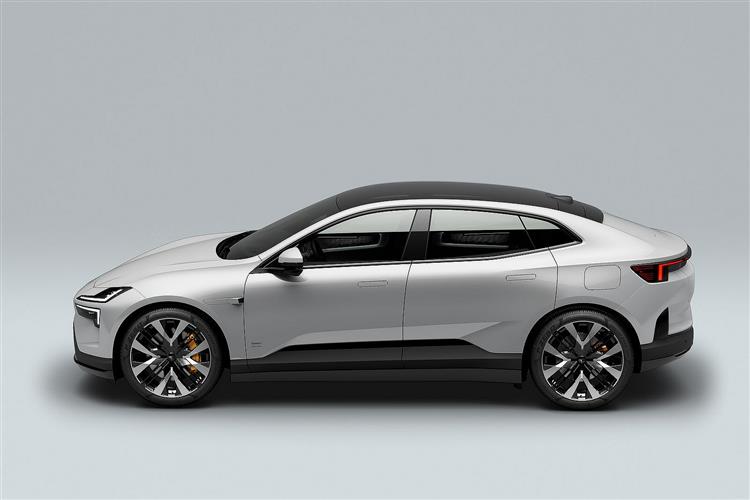
In its original form, the Polestar 4 looked like this - what the brand now calls the Polestar 4 Coupe, a variant which sells alongside the alternative, boxier SUV model. The Coupe is the more avant garde bodyshape, nothing quite like any of its talented premium badged mid-sized EV rivals, and remains a desirable trinket for the right kind of customer. Here, we look at the recently updated version.
Backgroundword count: 178
The Polestar 4 was always intended to be a different kind of Polestar. A different kind of EV. And in this, its trendiest form, the brand reckons, a different kind of mid-sized SUV-Coupe. It was originally launched in late 2023 in the guise we look at here, what the Sino-Swedish brand now calls the Polestar 4 Coupe, a car fitting into the company's line-up between the smaller Polestar 2 and larger Polestar 3 EVs. And in its first two years on sale, overtook the smaller Polestar 2 to become the brand's best-selling model in the UK. Key rivals in the mid-sized EV crossover segment include the Tesla Model Y and the BMW i4 but unlike those competitors, the Polestar 4 Coupe had an exterior design party piece - the absence of a rear window. That feature was reinstated when the '4' line-up was broadened in Autumn 2026 by the arrival of a second bodyshape, that of the boxier Polestar 4 SUV. But this rearwindow-less Coupe version continued on sale and features some useful updates in its latest form.
Driving Experienceword count: 506
This Polestar 4 might not be that much bigger than a Polestar 2 but it's very differently engineered. Under the skin lies the Geely 'SEA' (or 'Sustainable Experience Architecture') platform that we've seen used in an extraordinarily wide cross-section of cars - everything from a compact smart #1 to a large luxury Lotus Emeya. And the only battery available bolted to it is much larger than you'd get in a '2', 100kWh in size, 94kWh of which is actually usable. In short, it isn't only the looks of this car that make it a more ambitious thing than other mid-sized EV crossover models. The drivetrain choice on offer feels more familiar. Either the Rear motor version we tried; or, if there's more in the budget, a punchy Dual motor variant that feels quite different and is for those after some serious speed. As you'd expect, it's the Rear motor version that most customers choose, which offers 268bhp, 0-62mph in 7.1s and a range of 385 miles. It's all you really need, unless you're set on taking on faster rivals like the Tesla Model Y Performance or the Porsche Macan Electric 4S, in which case you'll need the Dual motor variant's extra thrust. With that top model, adding an extra identical motor to the front axle boosts total output to 536bhp and nearly doubles pulling power from 343Nm to 686Nm, lowering the 62mph sprint time to just 3.8s, without too much cost to EV range - a still-respectable 367 miles. Maximum speed on all models is limited to a quite un-EV-like 124mph. The Dual motor derivative can also be ordered in top Performance form, in which guise the car gets Polestar Engineered chassis tuning and beefier Brembo brakes. As for drive impressions of this Coupe model, well we'll start with this Sino-Swedish model's party piece first; you might wonder how you're going to adjust to manoeuvring about a car without a rear window. It actually doesn't take long at all. Two screen-selectable 'One Pedal Drive' brake regen options are offered, 'low' and stronger 'standard', which are all you really need. There are three steering weight options too but Polestar doesn't think you need any fake drivetrain sound effects. On this rear-driven version, rather curiously, there are no drive modes - though you do get them on the Dual motor variant - 'Range' and 'Performance' settings, plus Launch Control too. As the 12 o'clock marker on the steering wheel suggests, the brand wants its products to feel 'sporty', which inevitably means a somewhat firm standard of ride. Adaptive suspension is restricted to the Dual motor model. Even without that embellishment though, you could live with the standard passive set-up perfectly easily and it certainly promotes impressive body control through the bends. As part of product updates introduced in Summer 2026, Rear motor and Dual motor variants feature a recalibrated chassis with high-capacity passive dampers, new spring and anti-roll bar settings and polyurethane rebound stops replacing internal rebound coil springs. Polestar says that the steering's been made sharper too.
To see the full road test text contact us on 0330 0020 227
Pictures (high res disabled)
.jpg)
|
.jpg)
|
.jpg)
| |||
.jpg)
|
.jpg)
|
.jpg)
| |||
.jpg)
|
|
Statistics (subset of data only)
Min |
Max |
|
Price: |
£56,750.00 (At 16 Sep 2026, Rear motor Businesse Single motor) |
£71,250.00 (At 16 Sep 2026, Dual motor Performance Prime) |
Insurance group 1-50: |
45 |
48 |
Max Speed (mph): |
124 (Long range Dual motor) |
|
0-62 mph (s): |
3.7 (Long range Dual motor) |
|
Electric WLTP-Rated Driving Range (miles): |
367 |
|
Length (mm): |
4840 |
|
Width (mm): |
2139 |
|
Height (mm): |
1534 |
|
Boot Capacity (l): |
526 |
|
... and 2 other stats available | ||
Scoring (subset of scores)
Category: Hybrid, Plug-in, Electric & Hydrogen
| Performance | |
| Handling | |
| Comfort | |
| Space | |
| Styling, Build, Value, Equipment, Depreciation, Handling, Insurance and Total scores are available with our full data feed. | |