
A GREATER EIGHT (some text hidden) SECTIONED_new_peugeot308_2026
By Jonathan Crouch
Peugeot's third generation 308 family hatch has been updated and is now much improved. Jonathan Crouch drives it.
Ten Second Reviewword count: 62
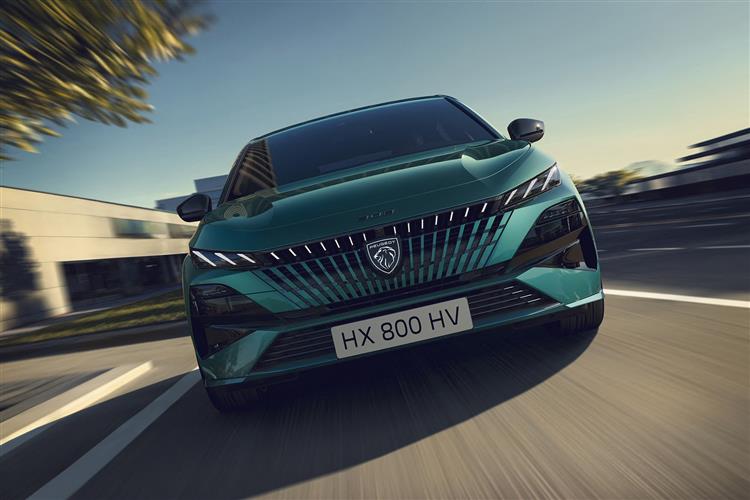
This third generation version of Peugeot's 308 gets a useful package of mid-term updates that see both family hatch and SW estate bodyshapes gain a smarter look. The engineering's also been updated in recent times and the result is a more desirable product than you might expect from this familiar Gallic brand. You might be surprised at how much you'd like it.
Backgroundword count: 150
You might not have ever thought of the Peugeot 308 family hatch as being truly aspirational but maybe it's time to start. Peugeot's been making Golf-class models for half a century and we're currently mid-way through the third generation of the one badged '308', a model we first saw in 2021. Here, our task is to check out the updated version of this P5-generation design, which claims to be the most up-market 308 yet, in keeping with the Peugeot brand's more premium positioning within the Stellantis Group. Earlier generation 308 models weren't really cars many customers would have chosen in preference to a Golf, let alone anything premium, but this enhanced MK3 design might be. Introduced in Summer 2025, it gains a much sharper look - and there have been key recent engineering changes too. So, premium values with mainstream value? Is that what we've got here? Let's find out.
Driving Experienceword count: 495
The 308 was always recognised amongst the sharper steers in the family hatchback segment; that hasn't changed. Not much has changed with the engineering of this 308 either - as before, you have to have some sort of auto gearbox. And rather surprisingly Peugeot was still retaining its 1.5-litre BlueHDi diesel engine within the line-up at the time of this test (with 8-speed auto transmission), though we don't expect that unit to continue for very long. Just before this update, the petrol Hybrid variant we tried for this test gained a slightly upgraded 145hp version of the previous 136hp self-charging unit. As before, this set-up sees a 1.2-litre three cylinder turbo petrol engine mated to a dual-clutch 6-speed auto with an electric motor built into the transmission casing. On the move, the Hybrid system's petrol unit and that electric motor can operate together - or separately. This is really a mild hybrid system rather than a proper Toyota-like full-Hybrid set-up, but it can do most of the things you'd want a Hybrid to do, like cut in for up to 50% of the time to assist the engine in urban travel. Unlike with the sort of mild hybrid system like that fitted to say, a Golf eTSI, here the car can be driven for short urban distances (under 18mph) on electric power alone. The motor also assists the engine under acceleration. 0-62mph in the Hybrid takes 9.3s en route to 130mph. What about if you want to plug your 308 in? Well just before this facelift, Peugeot introduced far-reaching changes to the PHEV drivetrain, limiting total power output to 195hp, adding a new 7-speed auto gearbox and including a bigger 17.2kWh battery. This Plug-in Hybrid 195 e-DSC7 package mates a 1.6-litre PureTech petrol engine with a 109hp electric motor. For this update, that set-up's been tweaked further, with the result that EV driving range rises to as much as 59 miles (from a best of 49 miles) before - though that's still way off the 82 miles you'd get from a rival VW Golf GTE PHEV. 0-62mph in the PHEV takes 7.9s en route to 140mph. Perhaps the biggest engineering change as part of this facelift though, has been applied to the all-electric E-308. It still features the same front-mounted 156hp motor, but now trades its old 51kWh (usable-capacity) battery for a slightly larger 55.4kWh package. With the result that EV drive range rises from to 279 miles in the E-308 hatch model (it's 4 miles less with the E-308 SW); that's about 25 miles better than before. Another key change to the E-308 as part of this facelift has been the adoption of adjustable brake regeneration. Instead of the old single-setting 'B' button next to the gear selector, there are now paddleshifters behind the steering wheel which can vary brake regen via three settings (though there's still no 'one-pedal' drive setting). E-308 performance hasn't changed much though; 0-62mph takes 9.8s en route to 106mph.
To see the full road test text contact us on 0330 0020 227
Pictures (high res disabled)
.jpg)
|
.jpg)
|
.jpg)
| |||
.jpg)
|
.jpg)
|
|
Statistics (subset of data only)
Min |
Max |
|
Price: |
£29,995.00 (At 12 Nov 2025, Hybrid 145 Allure) |
£40,395.00 (At 12 Nov 2025, Plug-in Hybrid GT SW) |
CO2 (g/km): |
102 (Hybrid 145) |
26 (Plug-In Hybrid) |
Max Speed (mph): |
130 (Hybrid 145) |
140 (Plug-in Hybrid) |
0-62 mph (s): |
9.3 (Hybrid 145) |
7.6 (Plug-In Hybrid) |
Electric WLTP-Rated Driving Range (miles): |
53 |
|
Combined Mpg: |
62.6 (Hybrid 145) |
242.7 (Plug-In Hybrid) |
Length (mm): |
4367 |
|
Width (mm): |
1852 |
|
Height (mm): |
1441 |
|
... and 2 other stats available | ||
Scoring (subset of scores)
Category: Compact Family Cars
| Performance | |
| Handling | |
| Comfort | |
| Space | |
| Styling, Build, Value, Equipment, Depreciation, Handling, Insurance and Total scores are available with our full data feed. | |