
VERSATILITY AND VALUE (some text hidden) SECTIONED_new_toyotaproaceverso_2020
By Jonathan Crouch
Introductionword count: 96
If you're looking for a large used MPV from this century's second decade, it would be very easy to spend an awful lot on a big People Carrier and still only end up with space for seven people. That may be all you want of course but even so, you might still be tempted by the thought that much the same money could buy you a smart car-like People Carrier with room for up to nine. Between 2016 and 2022, that was the proposition on offer from this model, the diesel version of Toyota's Proace Verso.
Modelsword count: 11
5dr SUV (1.6,1.5 diesel / 2.0 BlueHDi diesel) [Shuttle, Family, VIP]
Historyword count: 298
What do you do if a big MPV just isn't big enough? The motor industry's usual answer is to offer up something based on a medium-sized van - which doesn't sound that appealing does it? But People Carriers of this kind have improved a great deal in recent years and if you want proof of that, then just try this one, Toyota's Proace Verso. Toyota has rarely been a marque to miss an opportunity. That's why it's been so successful over the years. Over the last decade or two, the brand has been co-operating with European conglomerate Stellantis (formerly PSA) in development of its medium-sized LCVs. The PSA/Stellantis marques were keen that the commercial vehicle this produced should also spawn a proper super-large-segment People Carrying MPV, as indeed it did, Peugeot's version named the Traveller and Citroen's tagged as the Space Tourer. There was also a Vauxhall variant, the Vivaro Life. Joining in, Toyota created a super-large MPV from these same underpinnings too - which is what brought us the Proace Verso. Launched in 2016, this model marked Toyota's return to the large MPV segment, a market sector it'd been absent from since the demise of the Previa back in 2007. As the name suggested, this model shared plenty with the Japanese company's Proace van, but customers were promised that the driving and ownership experience would be anything but 'van-like'. Smart looks, high equipment levels and sophisticated technology seemed to bear that out. This model was first available with a choice of 1.6 or 2.0-litre diesel engines, the 1.6 replaced in 2018 by an (also Stellantis-derived) 1.5-litre unit. The Proace Verso in diesel form was discontinued in 2022, but re-launched in 2024 in full-electric EV form. It's the 2016-2022-era diesel version of this model we look at here.
What You Getword count: 519
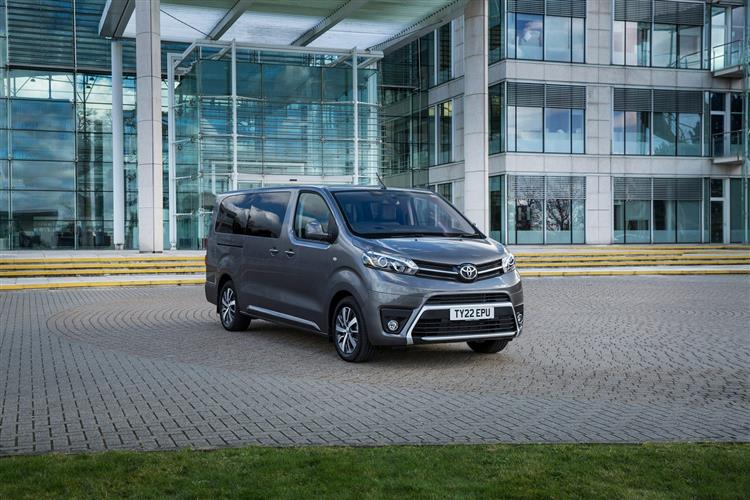
This model's frontal design firmly identifies it as a modern Toyota, with an upper grille that extends smoothly into the angled headlamp units and a large, trapezoidal lower grille surrounded by silver trimming, an aperture that aims to emphasise the car's width and solidity. There are two main Proace Verso body sizes - 'Medium' and 'Long' (though a smaller 'Compact' body shape was initially offered at the 2016 launch, then quickly phased out due to lack of demand). In terms of body length, you're talking around 5.0 or 5.3-metres, depending on the variant you choose, so either way, you're going to need a very big garage. The dashboard design features clear, analogue dials and ergonomic switchgear and there's excellent all-round visibility from the elevated, SUV-like driving position. The rather small 7-inch 'Pro-Touch' centre dash infotainment screen is borrowed from PSA/Stellantis, though Toyota was allowed to put its own blue background on the various screen options. The Combi and Shuttle models have a two-person front passenger seat to achieve their 9-seat capacity. Otherwise, you get the usual two separate chairs, each complete with an armrest. What about the rear? Well most variants get three seats in the middle row and they slide forward and back in a 60:40-split, plus the seat backs recline. If you've got a version with the optional 'Premium Pack' (or gone for a top 'VIP' model), you'll get a Skyview panoramic roof with two glass overhead panels and overhead vents (there are four) and overhead climate controls, along with overhead reading lights. Getting into the very back requires you to push the seat base forward, then retract the seat back forward. How many seats you get in the third row will depend on the spec you've chosen. Normally, as in the mid-range 'Family' model, there'll be three seats in the very back, but in the top 'VIP' variant, there are just two. Once in the third row, there's far more space than you'd get in a conventional large Galaxy or Sharan-style 7-seat MPV from this era: the van-based approach really pays dividends here, in terms of both leg and headroom. To increase legroom, you can use the provided red lower tabs to slide the seats ahead of you forward and back. Or if you're broad of back, the second row seats can be taken from their lower runners, then turned around to face those in the rear, facilitating impromptu business conferences on the move. Let's finish with a look at luggage capacity. If you'd forgotten that this was a van-based MPV, you're reminded of the fact when you come to raise the vast tailgate. Even with all the three seating rows upright, there's quite a lot of luggage space (in the 'Medium'-length model, between 603 and 798-litres, depending on the positioning of the 3rd row chairs). You push the 3rd row seats forward by pulling on two red tabs. And fold the seat backs using black levers - do that in the 'Medium'-length model and you can increase your luggage capacity to as much as 1,000-litres; or 1,750-litres with the second row seat backs folded too.
To see the full road test text contact us on 0330 0020 227
Pictures (high res disabled)
.jpg)
|
.jpg)
|
.jpg)
| |||
.jpg)
|
.jpg)
|
.jpg)
| |||
.jpg)
|
.jpg)
|
.jpg)
| |||
.jpg)
|

|
Scoring (subset of scores)
Category: MPV People Carriers
| Performance | |
| Handling | |
| Comfort | |
| Space | |
| Styling, Build, Value, Equipment, Depreciation, Handling, Insurance and Total scores are available with our full data feed. | |