
THE CLASSIEST LEXUS CONVERTIBLE (some text hidden) SECTIONED_new_lexuslcconvertible_2021
By Jonathan Crouch
Introductionword count: 91
The LC Convertible was, says Lexus, "one of the most sought-after vehicles we've produced". Launched in 2020, it was the first time the brand had properly ventured up towards the three-figure price bracket and to justify that, this open-topped sports car had to be very desirable indeed. It was. It came equipped to take on the luxury convertible segment's very top contenders, with drive dynamics that worked on the track as well as on the highway. Plus there's styling that'll cause a stir in the High Street and a gorgeous cabin.
Modelsword count: 9
2dr Convertible (5.0 V8) - [standard, Luxury, Premier, Takumi]
Historyword count: 169
This car, said Lexus back in 2020, signalled the future direction of its brand. Clearly then, the LC Convertible was significant - more than just a derivative of the impressive LC Coupe. In theory, like the fixed-top LC model, it was aimed directly at the BMW 8 Series and the Porsche 911. And for the LCC version, there was only a powerful conventionally engined V8 petrol available. Unlike the fixed-top LC, there was no Hybrid-engined alternative - which made this the only model in the whole Lexus line-up in this period that featured no hybrid engine electrification of any kind. Another first for the company was found in this convertible's use of a folding fabric top. Previous Lexus convertibles - the SC 430 of 2001 and the IS 250C of 2009 - had folding metal roof panels, which didn't do either model any favours in the beauty stakes. This LC Convertible, in contrast, was a very good looking piece of designwork indeed. It sold until 2024 and wasn't replaced.
What You Getword count: 595
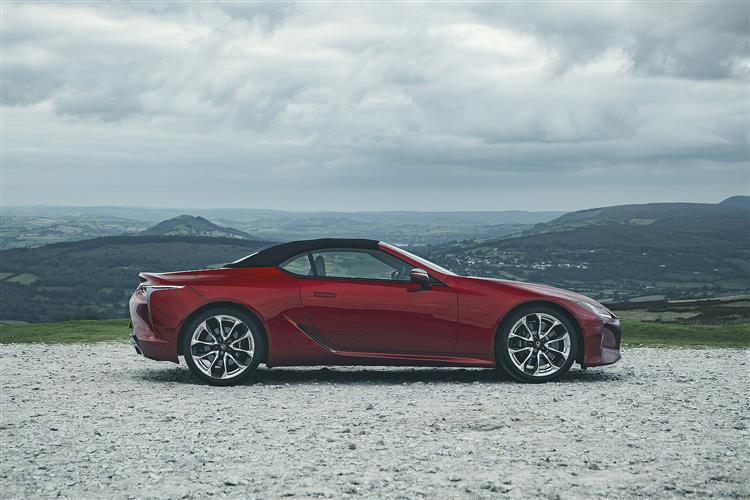
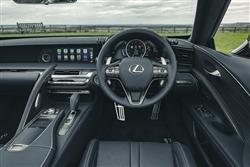
Lexus likes to set itself high aspirations in engineering and design. Here, the objective was to create 'the world's most beautiful open topped car'. No pressure then. Unlike its two open-air Lexus predecessors, this car has a fabric folding top, not an origami-style folding roof made up of heavy metal panels. As you'll see when activating the roof, which raises in just 15 seconds. Making the silhouette attractive with the top up was a major priority for Chief Designer Tadao Mori. As he correctly pointed out, few convertibles manage to be stylish and elegant with their roofs in place - but, to our eyes anyway, this one does. One of the principle design challenges was to minimise bulkiness in the bodywork in the shoulder area immediately behind the rear seats. This was achieved by creating an extra fold in the soft top so that it can be stowed in the area behind those rear seats, between the left and right suspension towers. Once inside, you're treated to the usual Lexus 'Omotenashi' Japanese welcome, that word encapsulating the ancient Oriental concept that describes one's ability to anticipate the needs of another, even before they arise. So you're looked after by seat heaters, neck heaters and a heated steering wheel, all of which are automatically activated depending on the outside temperature and the position of the fabric top. With the roof down, the temperature and climate system airflow volume are automatically regulated according to factors such as the amount of sunlight, the outside temperature and the vehicle speed. The leather seats are absolutely superb, as they should be in any good GT Convertible. They feature a clever two-part design in which the main part of the seatback drapes over the shoulder area of the seat and wraps around the back. There's more unique design in the unusual instrument binnacle you view through this three spoke wheel which, though a touch over-buttoned, feels great to hold. The gauges you view are based on those of the brand's old LFA supercar, with a central virtual rev counter and digital speedo dial that on the press of a steering wheel button slides sideways to the right to reveal another screen with trip computer, audio, safety and settings options. What about the rear seats? Yes you do get them. You wouldn't do on rival Jaguar F-TYPE and Aston Martin Vantage Convertible models. Though if you use the mesh wind deflector (which most original owners specified), you won't be able to use them. Unfortunately, the room on offer turns out to be horribly tight - which you kind of expect on a small cheap convertible, but feel less inclined to forgive in a larger, more expensive one like this. Legroom is extremely tight and when the top's up, the sloping roofline means that even adults of quite normal height will have their necks uncomfortably cricked against the roof lining. Let's finish with a look at boot space. Earlier, we mentioned the way that the soft top's extra fold allowed for a more compact roof sandwich that can be stowed directly behind the rear seats (alongside the hydraulic motor system). In theory, this should mean less of an encroachment on boot space, which is important because the standard LC Coupe doesn't have much of it - just 197-litres - a bit of a major failing for a luxury sports GT. Despite all that design ingenuity, the cargo area shrinks in size here to 149-litres. There are four silver tie down points but the under-floor area is taken up with a battery. Pack light.
To see the full road test text contact us on 0330 0020 227
Pictures (high res disabled)
.jpg)
|
.jpg)
|
.jpg)
| |||
.jpg)
|
.jpg)
|
.jpg)
| |||
.jpg)
|
.jpg)
|
.jpg)
| |||
.jpg)
|
|
Scoring (subset of scores)
Category: Convertibles
| Performance | |
| Handling | |
| Comfort | |
| Space | |
| Styling, Build, Value, Equipment, Depreciation, Handling, Insurance and Total scores are available with our full data feed. | |