Aston Martin DBX - ABC Leasing
SHAKEN - AND STIRRED(some text hidden)
By Jonathan Crouch
Ten Second Review word count: 58
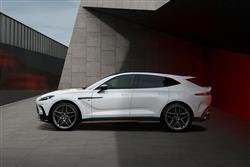
A sabre in a segment of sledgehammers. Is that what the Aston Martin DBX is? An Aston Martin SUV is already something pretty unique. With over 700PS, lots of attitude and a top speed knocking on the door of 200mph, this is better. The DBX now comes in 707, GT and S forms and has been usefully evolved.
Background word count: 160
Back in 2020, Aston Martin launched its first SUV, the DBX - and created it very much with what is now the mainstream version, the DBX707, in mind. The DBX707 first arrived in 2021. Customers loved what was then the top variant - so much so that it quickly accounted for two-thirds of sales. Hence when the time came in early 2024 for a mid-term DBX update, the brand decided to delete the lower-powered standard DBX derivative entirely. This improved model got enhanced cabin screen tech, but otherwise, the changes were subtle. There was still space though, the Gaydon engineers thought, for DBX variants to slot in above the 707, hence in Spring 2025 the introduction of the DBX S, with 727PS. Followed 18 months later by the more luxury-oriented DBX GT, which has the same 727PS output. With both models, the idea was to truly unlock the performance potential within the DBX to create a world-beating high performance SUV.
Driving Experience word count: 507
There are three DBX models, starting with the DBX707. As the name suggests, this puts out 707PS from its Mercedes-sourced 4.0-litre twin turbo V8 and there's 900Nm of torque. As a result, the 62mph sprint time takes just 3.3s and the top speed is 193mph. That kind of performance would eventually wreck an ordinary auto gearbox, so a 9-speed 'wet clutch' auto transmission is installed, better capable of handling the grunt and dealing with the extra 'Race Start' feature added into the car's 'GT Sport' and 'Sport+' drive modes. The electronic limited slip rear differential is re-engineered for all this torque too, as are the brakes (they're of the track-level carbon ceramic kind). Plus the Electronic Active Roll Control set-up features parameters that heighten the sense of agility and improve the aggressive balance of the car. If you need even more DBX, Aston will point you towards the DBX GT and DBX S models. These both put out 727PS - a 20PS power boost not enough to change the 707 model's core performance figures (though the brand claims that 124mph can be reached 0.3s faster). GT and S model changes include alterations to change points on the 9-speed auto (and more agressive downshifts); plus a slightly quicker steering ratio and potentially lighter weight (if all the right options boxes are ticked). Braking performance to match the power continues to be provided by the same carbon ceramic brake systems, measuring 420mm at the front and 390mm at the rear. As its name suggests, the DBX GT benefits from a unique suite of suspension enhancements giving it a more comfort-orientated 'Grand Touring' style of ride. That's thanks to a revised calibration of damper settings including a unique damper valve system which enhances ride compliance over poor surfaces while maintaining body control when driving dynamically. Whatever kind of DBX you decide upon, you might be surprised that, despite this model's modest 190mm of standard ground clearance, this Aston will properly go off road. The 4x4 rough surface settings are 'Terrain' (where the air suspension lifts the car higher) and 'Terrain+' (higher still). With everything raised, the car's approach angle can be as much as 25.7-degrees and the departure angle can be as much as 27.1-degrees, with a breakover angle of up to 18.8-degrees, plus there's Hill Descent Control for slithering down slippery slopes. All of it's enough to ensure that this car will go far further off road than any owner will ever need it to. Arguably more useful though, is the 500mm wading depth: there's even a breather pipe on the rear differential for situations such as reversing a trailer into water when launching a boat. But of course this car is much happier on tarmac, where the lack of semi-autonomous driving aids is a disappointment but journeying refinement is a pleasant surprise. That's no accident: there's a double-skin bulkhead, which acts like a noise-isolating structure between the cabin and the engine. Plus the Pirelli P-Zero tyres feature noise-reducing technology and the structure incorporates over 30kgs of sound-deadening material.
Pictures (High res disabled)
.jpg)
.jpg)
.jpg)
.jpg)
.jpg)
.jpg)
.jpg)
Scoring
Category: Compact Car
| Performance | |
| Handling | |
| Comfort | |
| Space | |
| Styling | |
| Build | |
| Value | |
| Equipment | |
| Economy | 40% |
| Depreciation | 50% |
| Insurance | 40% |
| Total | 65% |
Mobile
Narrow
Narrower
Normal
Wide