Audi Q3 e-hybrid - ABC Leasing
The independent definitive Audi Q3 e-hybrid video review
How will you view?
How will you view?
This is a sample, showing 30 seconds of each section.
HY ASPIRATIONS(some text hidden)
By Jonathan Crouch
Ten Second Review word count: 41
Audi pushes the boundaries of what customers might be prepared to pay for a compact Plug-in Hybrid SUV with this car, the Q3 e-hybrid. But it might be a better choice than that compact premium EV crossover you were thinking about.
Background word count: 77
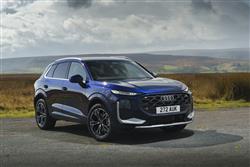
Compact plug-in hybrid SUVs have got pricey. But they've also got a lot better. For proof, check out this one, Audi's Q3 e-hybrid. This is the MK3 model Q3. There was a PHEV version of the MK2 version but it wasn't much chosen because it cost a lot and only went 32 miles between spells of battery replenishment. This replacement design also costs a lot but now claims to go a genuinely useful 70 miles between charges.
Driving Experience word count: 200
Disappointingly, the Q3 doesn't get the advanced 2.0-litre Plug-in Hybrid drivetrain we've seen in the larger Q5. Just a further developed version of the previous PHEV petrol set-up borrowed from the A3, which sees the TFSI model's 1.5-litre four cylinder unit mated with six-speed dual clutch transmission and a 25.7kWh battery offering an EV range of up to 74.4 miles - a huge increase over the feeble 32 mile figure of the previous MK2 Q3 TFSI e model. As usual in a VW Group PHEV, you can save battery charge for later in your trip when you might need it. The Q3 e-hybrid's peak power is 272PS, with 400Nm of torque. 0-62mph takes 6.8s en route to 134mph, so it's not slow. On all Q3s, the standard 'comfort' suspension set-up seems well-judged over tarmac tears and potholes; if you regularly encounter those, we'd steer clear of the firmer passive 'sport suspension' set-up found on pricier variants. Beyond the city limits, the light, accurate steering feels good and body roll's kept well in check, though you'll feel this e-hybrid version's extra 150kg of kerb weight through the turns. On the highway, refinement's excellent, but overtaking means working the engine quite hard.
Pictures (High res disabled)
.jpg)
.jpg)
.jpg)
.jpg)
.jpg)
.jpg)
.jpg)
.jpg)
.jpg)
.jpg)
Scoring
Category: Compact Car
| Performance | |
| Handling | |
| Comfort | |
| Space | |
| Styling | |
| Build | |
| Value | |
| Equipment | |
| Economy | 70% |
| Depreciation | 70% |
| Insurance | 70% |
| Total | 68% |
Mobile
Narrow
Narrower
Normal
Wide