
SKODA ON A CHARGE (some text hidden) --NONE--
By Jonathan Crouch
Skoda's Enyaq electric family hatch gets a further useful update. Jonathan Crouch drives it.
Ten Second Reviewword count: 85
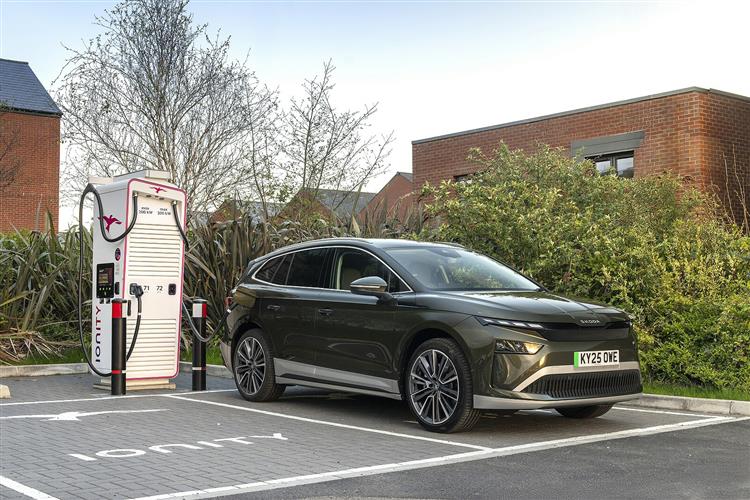
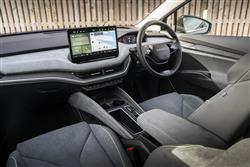
The Enyaq was Skoda's very first EV and in this further improved form, continues to use its Volkswagen Group EV technology to good effect, while still managing to incorporate a very Skoda look and feel. This additional update brings better infotainment, more luggage room and enhanced drive assist features. And in terms of drive range, equipment and cabin space, both SUV and Coupe versions of this car will continue to look attractive in the showroom for those who get the right price or lease deal.
Backgroundword count: 268
Back in 2021, Skoda finally brought us its very first full-electric car, the Enyaq, then known as the 'Enyaq iV' and a model that started a bold new era in Skoda design. First launched as a boxy SUV hatch, followed two years later by an SUV-Coupe variant, this was the Czech brand's take on VW Group EV engineering - and successful it proved to be, with over a quarter of a million versions of this car sold in its first four years of production. By early 2025 though, competition had ramped up substantially, so Skoda introduced a mid-term Enyaq update, further built upon by a package of improvements introduced in Spring 2026, which created the car we're going to look at here. Despite it being frequently Europe's most popular electric car, the original Enyaq was, in truth, a slightly confusing product. Not just because it was Skoda's first EV, rear-driven and enormously heavy but also because of its design conundrums. It looked mid-sized but was priced compact. It claimed to herald 'a new era in electric Skoda motoring' but had an enormous combustion-style grille. And the 'iV' in its model name was the same as the brand had used on its fossil fuel Plug-in Hybrids. So in the last few years, Skoda has had some sorting out to do with this car - and some repositioning too, after the arrival of its second EV in 2024, the only slightly smaller Elroq. So is there still an important place for the Enyaq in the Skoda EV line-up? And how does it fare against more recently introduced EV segment rivals?
Driving Experienceword count: 519
Given recent updates made to this car's Volkswagen ID.4 and Ford Explorer MEB platform segment cousins, we had expected a few EV drivetrain changes for this further updated Enyaq, but those are clearly still to come. What Skoda has added is an extra 'one-pedal' energy recuperation mode for the brake regen system, which (with the gear shifter set in B) means that the car can virtually bring itself to a stop when you come off the throttle. The Enyaq's ADAS drive assist features are also more adanced with the introduction of a new 'Travel Assist 3.0' system with new radars and sensors for more precise guidance. The car can even now stop itself at traffic lights and STOP signs. As before, to expect engaging driving dynamics from a car of this kind is clearly over-optimistic; realistically no Enyaq weighs in at under 2-tonnes. To hope for journeying refinement is a little more realistic; aided the sleek bodywork, this Skoda serves up plenty of that. As for ride quality, well as we said in our test of the smaller Elroq, it's pretty good by class standards - but could be so much better if body control wasn't so tightly reined-in to satisfy the industry press. You'll hear more positive comments about Enyaq ride quality elsewhere, but that's usually because the testers concerned have been in a version of this car fitted with the DCC adaptive chassis control system that hardly any customers will specify. The name 'Enyaq' is apparently derived from the Irish word 'Enya', meaning 'source of life', the source in this case being the same two-way choice of 63 and 82kWh battery packs that the Enyaq has used for some time now. The smaller 63kWh battery pack (which can't be had on the Coupe version of this car) features in the base 60 model allied to a 204PS motor which takes you to 62mph in 7.8s or, if you're more restrained, offers a range of up to 269 miles. We tried a mid-level 85 model with the larger 82kWh pack which works with a 286PS motor, this combination delivering a sprint time of 6.5s and a range figure of up to 359 miles. Further up the line-up lie the 82kWh AWD dual motor variants; the 85x model with 334 miles of range. And a top vRS variant that offers 340PS, 0-62mph in 5.2s and 344 miles of range. Since your budget will probably restrict you to a single motor model, that's what we opted to try. In case you're not familiar with VW Group engineering in EV of this size, it's worth pointing out that, unlike quite a few rivals, the motor in question sits on the rear axle rather than the front one. Which prior to this Enyaq's original introduction was a format we hadn't seen in any Skoda since the '70s. Here, it allows for a turning circle that at just 9.3-metres is so impressive that you might wonder whether this car has 4-wheel steering (it doesn't). When fitted with an optional folding towbar, any Enyaq is also capable of towing trailers weighing up to 1,400kg.
To see the full road test text contact us on 0330 0020 227
Pictures (high res disabled)
.jpg)
|
.jpg)
|
|
Statistics (subset of data only)
Min |
Max |
|
Price: |
£38,020.00 (At 22 Apr 2026, 60 SE L [inc £1,500 ECG grant]) |
£54,305.00 (At 22 Apr 2026, vRS Coupe) |
Insurance group 1-50: |
27 |
34 |
Max Speed (mph): |
99 (60) |
112 (vRS) |
0-62 mph (s): |
9.1 (60) |
6.2 (vRS) |
Electric WLTP-Rated Driving Range (miles): |
269 |
|
Length (mm): |
4649 |
|
Width (mm): |
1879 |
|
Height (mm): |
1616 |
|
Boot Capacity (l): |
570 |
585 |
Power (ps): |
204 (60) |
340 (vRS) |
Scoring (subset of scores)
Category: Hybrid, Plug-in, Electric & Hydrogen
| Performance | |
| Handling | |
| Comfort | |
| Space | |
| Styling, Build, Value, Equipment, Depreciation, Handling, Insurance and Total scores are available with our full data feed. | |