
C-CHANGE (some text hidden) --NONE--
By Jonathan Crouch
Mercedes' fifth generation C-Class has taken a useful step forward, thinks Jonathan Crouch
Ten Second Reviewword count: 53
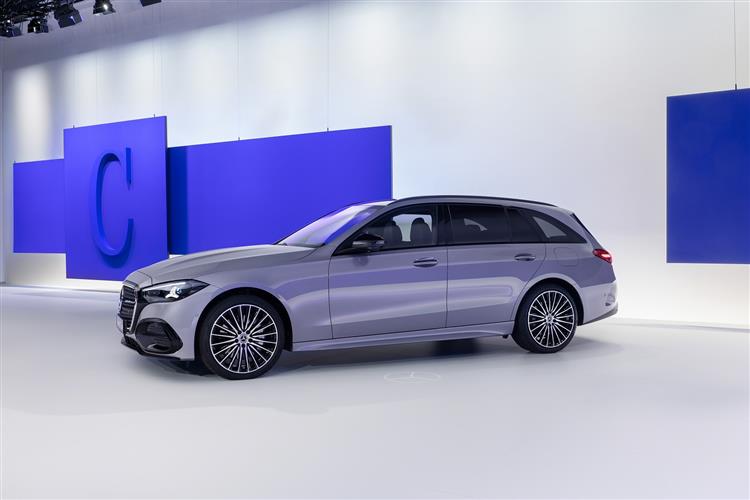
Mercedes has rejuvenated its important C-Class model for a new era, significantly updating the combustion saloon and estate versions of this fifth generation W206-era design to reflect the look of the added all-electric version. As before, this premium lower mid-sized model brings more than a dash of S-Class luxury to this important segment.
Backgroundword count: 243
Once, if you thought of a Mercedes you thought of a large limo. But for the last three decades, the model that has more readily sprung to mind is the C-Class. Here, we're looking at the very extensive update made to the fifth generation W206 version. With this car, Mercedes still wants you to think of a large limo, calling it a 'mini S-Class'. Though the C-Class isn't quite as important a model for the brand as it once was (the smaller CLA now out-sells in the UK), it remains a defining contender for the marque. Especially since the arrival of the C-Class Electric, launched just before this combustion model update, whose controversial aggressive frontal look provided the inspiration for the visual changes made here. Under the new packaging, the changes made aren't particularly far-reaching, which you might think could be an issue given that the saloon and estate variants of this Mercedes are still priced above equivalent versions of their BMW 3 Series / i3 closest rival - and that Munich model is an all-new car. But since 1993, the draw of the Three-Pointed Star has delivered C-Class sales anyway. This model line has found 12 million new owners since the MK1 W202 version first arrived, followed by the W203 in 2000, the W204 in 2007, the W205 in 2014 and the current W206 generation in 2021. But is this latest car good enough to sell on more than just its badge?
Engines and Tech Specword count: 413
Obviously the big change with the W206-era C-Class going forward is that there's now a full-electric model, but in terms of the combustion versions, not a lot has been done to the engineering of this facelifted design. For the UK, the important news is that Mercedes doesn't want to sell diesel versions of this car any more - of either the mild hybrid or the PHEV kind, which is disappointing given that these variants carry on elsewhere in Europe. Mercedes says that the remaining mild hybrid petrol units that make up the bulk of the line-up have been revised to meet tougher Euro 7 emission standards. Specifically, the 48V system now powers a new electric compressor for the turbocharger, which is claimed to reduce turbo lag. Across the board, power and torque outputs of this rear-driven 9-speed auto model have slightly improved as a result. There are two main mild hybrid petrol options, starting with the C 250, which as before uses a turbocharged four cylinder 2.0-litre M 254 EVO engine mated to an electric motor and puts out 237bhp with 320Nm of torque, allowing for a 7.3 second 0-62mph time and a 154mph top speed. The alternative is the C 300, which uses a more powerful version of the same four cylinder unit and the same 48V mild hybrid set-up. Total power here is 278bhp with 400Nm of torque, which lowers the 0-62 mph time to 6.1 seconds and increases the top speed to 155mph. Mercedes also retains a very strong PHEV variant, the C 300e, capable of driving up to 65 miles on energy from its 19.5kWh battery. The C 300e uses the turbo 2.0-litre petrol engine and offers 347bhp, a little more than previously thanks to a small power increase for the petrol and electric motors. Mercedes has engineered the usual flagship high performance AMG models to complete the line-up. In all models, the chassis has been tweaked as part of this update, with stiffer dampers supposed to improve agility without compromising ride at cruising speeds. As before, adaptive damping and rear-wheel steering are optional on mainstream models. With rear-axle steering fitted, at lower speeds, the rear wheels steer in the opposite direction to the front wheels - by up to 2.5-degrees opposite to the front-axle angle during parking. This reduces the turning circle by 43cms to 10.64 metres. Go faster and the rear wheels turn slightly in the same direction as those at the front to improve corner turn-in.
To see the full road test text contact us on 0330 0020 227
Pictures (high res disabled)
.jpg)
|
.jpg)
|
.jpg)
| |||
.jpg)
|
.jpg)
|
.jpg)
| |||
.jpg)
|
.jpg)
|
.jpg)
| |||
.jpg)
|
.jpg)
|
.jpg)
| |||
|
Statistics (subset of data only)
Min |
Max |
|
Price: |
£46,995.00 (At 27 Aug 2026, C 250 Urban Edition Saloon) |
£64,265.00 (At 27 Aug 2026, C 300e Estate Premier Edition) |
Insurance group 1-50: |
33 |
46 |
CO2 (g/km): |
58 (C 300e) |
150 (C 300) |
Max Speed (mph): |
154 (C 250) |
149 (C 300e) |
0-62 mph (s): |
7.3 (C 250) |
6.1 (C 300e) |
Electric WLTP-Rated Driving Range (miles): |
65 |
|
Combined Mpg: |
42.9 (C 300) |
113 (C 300e) |
Length (mm): |
4766 |
|
Width (mm): |
1820 |
|
... and 4 other stats available | ||