
X BETTER MARKS ITS SPOT (some text hidden) --NONE--
By Jonathan Crouch
BMW re-set the standard for large, luxury EV Crossovers with this iX. Jonathan Crouch drives the improved version.
Ten Second Reviewword count: 46
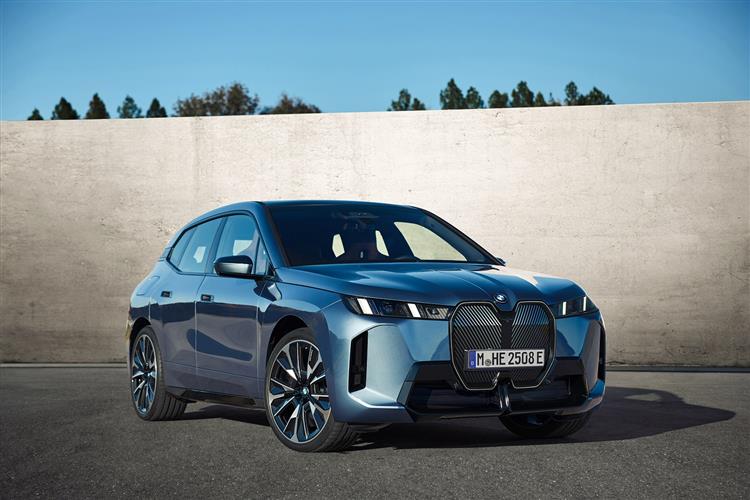
BMW has revitalised its large electric luxury SUV, the iX. A smarter look is matched by bigger batteries with greater EV range, plus there's sharper handling and more power too. In short, this car now makes more of a statement - in more ways than one.
Backgroundword count: 268
Back in 2021, BMW's iX large luxury SUV was claimed to represent everything the brand knew about EV technology, which turned out to be quite a lot. This was the brand's very first 4WD EV and it used the fifth generation of the Bavarian maker's e-motor and battery technology, bolted into a carbonfibre-rich structure that at original launch was more innovative than anything we'd seen from the company since the i3. In other areas, the iX looked less advanced - with its combustion model-influenced CLAR platform and relatively old-tech 400V electrical infrastructure. Those slight doubts we'd had at the original launch started to look a lot more acute four years into production, by which time the competition was starting to make this Bavarian model look a little dated, for all its futuristic looks. So the arrival of this significantly updated version of the iX for the 2025 Model Year was important. By then, this BMW had a portfolio of much tougher rivals to contend with, not only the Mercedes EQE SUV but also heavily evolved versions of the Polestar 3 and the Volvo EX90, with Porsche's Cayenne Electric readying to also join the fray in the premium part of the upper mid-sized segment. But despite its welcome updates, this much improved iX still represents older-tech BMW EV technology, rather than the cutting-edge 800V electrical infrastructure that undergirds more recent Neue Klasse electric models from the brand like the slightly smaller but longer-ranging iX3. So is there still a significant place for this iX in the Munich maker's EV model line going forward? Here, we're going to find out.
Driving Experienceword count: 486
Lots of engineering work's gone on as part of this update, with greater EV range and what BMW calls 'a major focus on driving dynamics'. As before, there's a choice of three iX variants, all using much the same twin-motor four wheel drive configuration - and they all get bigger batteries. Things kick off with the iX xDrive45, which now has a 100.1kWh battery (94.8kWh of which is usable, up from 71kWh with the previous xDrive40). The dual motor drivetrain of the iX xDrive45 now puts out a hearty 408hp and BMW quotes a 374 mile range (up from 257 miles with the old xDrive 40), which means that 62mph takes only 5.1s. Next up is the mid-level iX model, the xDrive60, which has a 112kWh battery (108.9kWh of which is usable, up from 105.2kWh for the old xDrive50). The xDrive60 offers 544hp from its dual motor drive system and range is officially rated at 427 miles (up 34 miles on the previous model), with 62mph in 4.5s. Both these two mainstream versions top out at 124mph. As before, the summit of the iX range is marked by an M version, but it's now called M70 rather than M60. This flagship variant's battery is basically much the same unit as that of the xDrive60, but the 668hp dual motor set-up (up from 619hp with the old M60) is considerably more powerful, taking this range-topper to 62mph in just 3.8s en route to 155mph. Range is up to 366 miles and this ultimate iX gets active rear steering and M Sport brakes. As before, across the iX line-up bolted to the aluminium-intensive chassis is a suspension set-up featuring double wishbone (front) and multi-link (rear) springs. An Adaptive two-axle Air Suspension system is optional on mainstream models, as is Integral Active rear-wheel Steering, both features being standard with this top M70 version, which also gets anti-roll bars and uprated M Sport brakes. BMW says it's worked on the dampers in all iX models for extra cornering stability. The engineers have also worked on the chassis to allow for the extra power - and subtly altered the weight balance, a small change but necessary when you want to try and improve the way that this car handles its prodigious 2.6-tonne kerb weight. Otherwise, it's much as before. There are 'High', 'Moderate' or 'Low' Brake Energy Regeneration settings. Plus activating driving position B with the selector lever generates so much off-throttle retardation that you'll virtually never have to use the brake pedal except when coming to a standstill. Using the alternative 'Adaptive' regen setting, the iX can also manage its own levels of brake recuperate to charge its battery on the move. When approaching a junction for example, the degree of recuperation will be increased. On the open road meanwhile, the coasting function sees the car 'freewheeling' with no drive power whenever the driver takes their foot off the accelerator.
To see the full road test text contact us on 0330 0020 227
Pictures (high res disabled)
.jpg)
|
.jpg)
|
.jpg)
| |||
.jpg)
|
.jpg)
|
.jpg)
| |||
.jpg)
|
.jpg)
|
.jpg)
| |||
.jpg)
|
|
Statistics (subset of data only)
Min |
Max |
|
Price: |
£75,315.00 (At 13 Jun 2025, xDrive45 Sport) |
£11,421.00 (At 13 Jun 2025, M70) |
Max Speed (mph): |
124 (xDrive45) |
155 (M70) |
0-62 mph (s): |
5.1 (xDrive45) |
3.8 (M70) |
Electric WLTP-Rated Driving Range (miles): |
366 |
|
Length (mm): |
4953 |
|
Width (mm): |
1967 |
|
Height (mm): |
1695 |
|
Boot Capacity (l): |
500 |
|
Power (ps): |
408 (xDrive45) |
668 (M70) |
Torque (lb ft): |
700 (xDrive45) |
1015 (M70) |
Scoring (subset of scores)
Category: Hybrid, Plug-in, Electric & Hydrogen
| Performance | |
| Handling | |
| Comfort | |
| Space | |
| Styling, Build, Value, Equipment, Depreciation, Handling, Insurance and Total scores are available with our full data feed. | |