
PASSENGER FERRY (some text hidden) --NONE--
By Jonathan Crouch
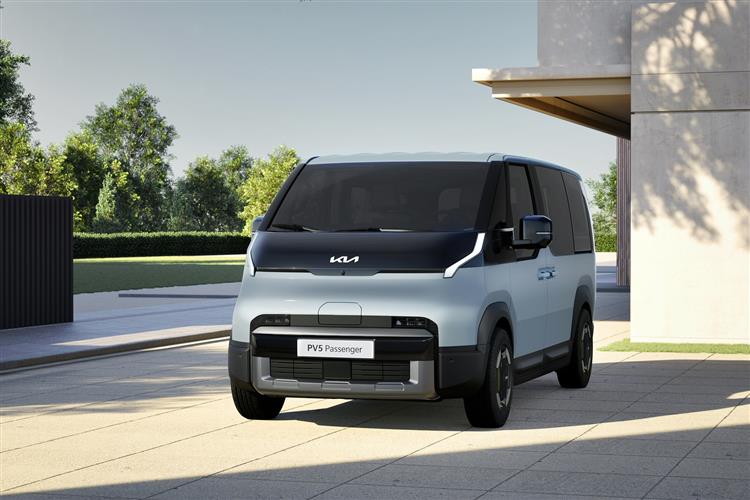
Kia's PV5 Passenger aims to shake up the market for big five or seven-seat MPVs. Jonathan Crouch drives it.
Ten Second Reviewword count: 49
It's about time a brand took a completely fresh look at the market for big van-derived five or seven-seat people carrying MPVs. Which is exactly what Kia has done with this all-electric PV5 Passenger model. Turns out that EVs of this sort can be cheaper, more spacious and cleverer.
Backgroundword count: 117
If you want big full-electric MPV with five or seven seats, you can either have something very van-like (most models in this segment are clearly LCV-derived). Or pay more for something quite avant-garde in the form of the Volkswagen ID.Buzz. But what if you could get a bit of both - and at a very affordable price? That's the thinking behind this car, Kia PV5 Passenger Sure (like the ID.Buzz) it shares its design with a van, but a very trendy-looking one, the PV5 Cargo. And it's been created in every way for passenger practicality. Mindful of the target audience, Kia even turned to Uber for help in its design. Sounds intriguing. Let's take a closer look.
Driving Experienceword count: 211
The PV5 Passenger sits on a 'commercialised' version of the E-GMP.S electric platform the Korean brand uses for its family EVs. Drive comes from a single front-mounted electric motor with 161bhp and there's a choice of two battery packs. Things kick off with the standard range 51.5kWh unit we tried, which offers up to 183 miles. You might though, want to stretch to the larger more usable 71.2kWh long range battery pack, which is mandatory with the 7-seat model and is capable of taking the PV5 up to 256 miles. The steering's light but refinement's excellent. You'll feel pot holes and speed humps, but not as much as in most rival van-based MPVs. Manoeuvrability around town is easy thanks to the glassy cabin. On the open road, performance is adequate, this standard range 51.5kWh version making 62mph in 12.8s, a figure the long range 71.2kWh model improves to 10.7s. Maximum speed for both versions though, is limited to just 84mph. Once you locate the drive mode button (it's at the base of the curiously-shaped two-spoke wheel), you can activate three different drive mode settings (Eco, Normal and Snow); and there are four brake regen options. Towing capacity is rated at 750kg for the standard-range version or 1,500kg for the long-range model.
To see the full road test text contact us on 0330 0020 227
Pictures (high res disabled)
.jpg)
|
.jpg)
|
.jpg)
| |||
.jpg)
|
.jpg)
|
.jpg)
| |||
.jpg)
|
|
Statistics (subset of data only)
Min |
Max |
|
Price: |
£31,695.00 (Estimated At 8 Jun 2026, Essential [inc £1,500 ECG]) |
£41,975.00 (Estimated At 8 Jun 2026, Elite LR 7-seat) |
Insurance group 1-50: |
25 |
29 |
Max Speed (mph): |
84 (71.2kWh) |
|
0-62 mph (s): |
10.7 (71.2kWh) |
|
Electric WLTP-Rated Driving Range (miles): |
183 |
|
Length (mm): |
4700 |
|
Width (mm): |
1895 |
|
Height (mm): |
1923 |
|
Boot Capacity (l): |
1320 |
2315 |
Power (ps): |
161 |
|
Scoring (subset of scores)
Category: Hybrid, Plug-in, Electric & Hydrogen
| Performance | |
| Handling | |
| Comfort | |
| Space | |
| Styling, Build, Value, Equipment, Depreciation, Handling, Insurance and Total scores are available with our full data feed. | |