
EVO LONGORIA (some text hidden) --NONE--
By Jonathan Crouch
BYD's Atto 3 now drives for longer in this EVO form. And that's just the start of what's changed here. Jonathan Crouch takes a look.
Ten Second Reviewword count: 45
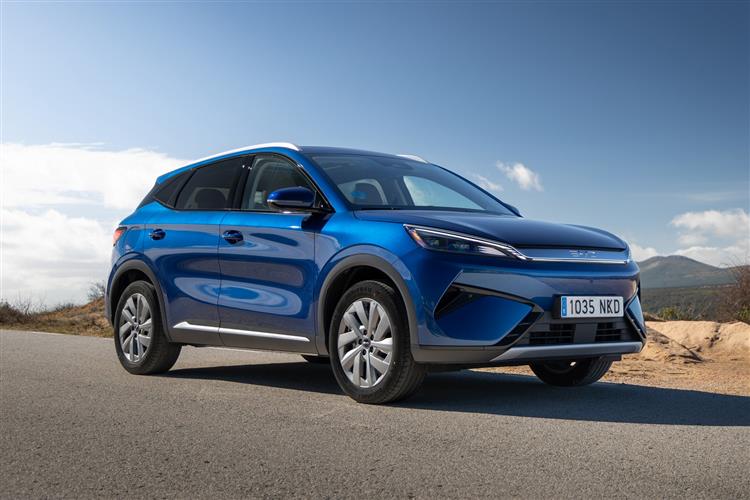
BYD has completely revitalised its lower mid-sized EV crossover, the Atto 3, to create this very different Atto 3 EVO model. It goes faster, charges quicker, feels much nicer inside, is better connected and now drives primarily from the rear. Time to reconsider one perhaps?
Backgroundword count: 201
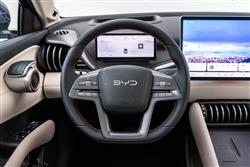
Back in 2022, what would turn out to be a remarkable Chinese brand launched an unremarkable car in the UK, its first, the BYD Atto 3, a lower-mid-sized EV. Since then, the company's astonishing sales growth has set the template for what all the many aspiring Oriental brands which have followed are trying to be. And so many new and tempting EV and Plug-in Hybrid BYD products have followed that the Atto 3 has got rather forgotten. Until the complete re-think with this model that in early 2026 created this car, the Atto 3 EVO. The name and the relatively light exterior makeover suggest this to be the kind of mid-term facelift that really wouldn't have helped this model much against all the many lower mid-sized electric crossover family hatchbacks that have been launched at the £35,000-£40,000 price point since this car's original introduction. But that's not what's on offer here. Switching from front to rear-wheel drive is a fundamental change; so is the move from 400V to 800V electrical infrastructure that brings vastly faster DC-charging. There's also now an under-bonnet 'frunk', a much more sophisticated infotainment system and more power than any segment rival. BYD doesn't do things by halves.
Driving Experienceword count: 512
How much power does an ordinary lower-mid-sized family hatch or crossover really need these days? Well the current electric era is gradually redefining the answer to that question, with extra braked horses no longer dependent on combustion size but merely a software tweak away. To begin with, EV makers have used this capability conservatively; even now, the starting total output norm in the class this BYD Atto 3 EVO competes in is no more than around 150-170PS. But as battery sizes get larger and manufacturer range anxiety lessens, you can expect that norm to rise significantly. As is evidenced here. You won't be expecting the 'EVO' tag added to this Atto 3 to make it into any kind of EV hot hatch, but the base RWD 'Design' version does now develop a hefty 313PS - about the same as a Golf R super hatch was offering a decade or so back in the combustion era. And today's Golf R, by the way, can get nowhere near the output total of the fastest Atto 3 EVO dual motor 'Excellence' model, which fronts up with an astonishing 449PS. Which is enough to get that top BYD to 62mph in just 3.9s, 1.6s quicker than the already impressive 5.5s stat of the RWD version. There are more significant things going on as part of this update than the mere addition of a prodigious slug of extra power. The Atto 3 EVO is effectively a completely different car from its predecessor under the skin, mainly because drive now comes predominantly from a motor on the rear axle, rather than one at the front. Only two other cars have ever undergone a similar mid-life transformation, both interestingly in this BYD's same class, the Volvo XC40 and the Polestar 2. An arguably even more significant engineering shift lies in the way that the Atto 3 EVO's drive battery - now increased in size from 60.4kWh to 74.8kWh - now no longer sits in a separate casing in the chassis but has its cells mounted in a 'cell-to-body' arrangement integrated into the vehicle floor. Which makes the car lighter and more rigid, so theoretically better to drive and more frugal. The 'better to drive' bit is helped by the switch from a four-link to a more complex five-link suspension arrangement. But it's also something that BYD is still working on. The light steering and intrusive ADAS features here might still put you off this car as much as was the case with its predecessor. But things are changing - and so is the drive range you can expect, up from the 260 mile figure of the original model to 316 miles with the RWD Atto 3 EVO 'Design' model. The weight of an extra motor on the front axle drops the range figure of the dual motor AWD 'Excellence' version (which has the same 74.8kWh battery as its lesser stablemate) to 292 miles. These figures of course require constant selection of the most frugal of the provided drive modes, Eco: the other three settings are Normal, Sport and Snow.
To see the full road test text contact us on 0330 0020 227
Pictures (high res disabled)
.jpg)
|
.jpg)
|
.jpg)
| |||
.jpg)
|
.jpg)
|
.jpg)
| |||
.jpg)
|
.jpg)
|
.jpg)
| |||
.jpg)
|
|
Statistics (subset of data only)
Min |
Max |
|
Price: |
£38,990.00 (At 24 Mar 2026, Design) |
£42,730.00 (At 24 Mar 2026, Excellence) |
Max Speed (mph): |
112 (Design RWD) |
|
0-62 mph (s): |
5.5 (Design RWD) |
3.9 (Excellence AWD) |
Electric WLTP-Rated Driving Range (miles): |
292 |
|
Length (mm): |
4455 |
|
Width (mm): |
1875 |
|
Height (mm): |
1615 |
|
Boot Capacity (l): |
490 |
|
Power (ps): |
313 (Design RWD) |
449 (Excellence AWD) |
Torque (lb ft): |
380 (Design) |
560 (Excellence) |
Scoring (subset of scores)
Category: Hybrid, Plug-in, Electric & Hydrogen
| Performance | |
| Handling | |
| Comfort | |
| Space | |
| Styling, Build, Value, Equipment, Depreciation, Handling, Insurance and Total scores are available with our full data feed. | |