
3 MOBILE (some text hidden) --NONE--
By Jonathan Crouch
Hyundai's smallest IONIQ model might also be its best. Jonathan Crouch takes a look at the IONIQ 3.
Ten Second Reviewword count: 37
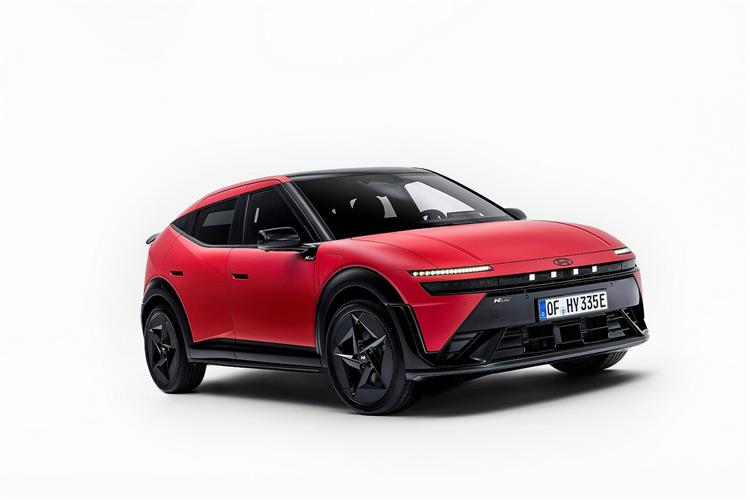
Hyundai muscles into the sector for compact EV hatches with this car, the IONIQ 3. It's aggressively styled and ambitiously designed. And it might just be the more interesting segment contender this class has been waiting for.
Backgroundword count: 119
The IONIQ 3 could hardly be more important for Hyundai. This compact EV is the smallest car yet in its IONIQ electric model line and the first full-battery model the Korean maker has built in Europe and designed specifically for our continent. Given that all of this makes the IONIQ 3 the most important electric Hyundai sold here to date, you might expect the company to play it somewhat safe with the design. But the Hyundai Motor Group conglomerate already has the almost identically-engineered Kia EV2 doing that in this segment. So the IONIQ 3 must stand out - and does. With aero styling, a novel dash design and sizing that blurs class boundaries. Let's take a closer look.
Engines and Tech Specword count: 286
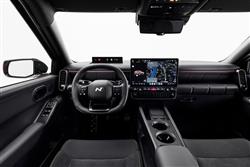
As the IONIQ 5N and 6N models have shown, Hyundai knows how to make fast, dynamically rewarding electric cars. Perhaps in future, a hot N version of this IONIQ 3 will be one of them but for the time being, the sporting looks of this compact EV hatch are the most sporty thing about it. As we've said elsewhere in this review, all the engineering is shared with the sensibly-orientated Kia EV2, which means The drivetrain bolted to the E-GMP platform offers a choice of two batteries. Of minority interest is the standard range 42.2kWh pack, paired with a 147PS front motor. Almost all IONIQ 3 customers will instead choose the larger long range 61kWh unit which, despite the extra bulk it lends to the kerb weight, must make do with a feebler 135PS motor, hence a 9.5s 0-62mph time that's 0.7s lower than the cheaper variant. Either way though, there's 250Nm of pulling power and top speed is 105mph for the 42.2kWh model, or 102mph for the 61kWh variant. More importantly, driving range is up to 213 miles for the standard range 42.2kWh version; and up to 308 miles for the 61kWh long range variant. The small wrist flick-sized steering wheel will make the car feel a little more agile than it actually is. You can expect refinement to be excellent thanks to the slippery shape. On the highway, you'll certainly appreciate the trouble the brand has gone to in order to limit road, tyre and suspension noise. There's a brake regen system of course - controlled by paddles behind the steering wheel, with modes including a full-on 'i-Pedal' setting which will bring the car virtually to a stop when you come off the throttle.
To see the full road test text contact us on 0330 0020 227
Pictures (high res disabled)
.jpg)
|
.jpg)
|
.jpg)
| |||
.jpg)
|
.jpg)
|
.jpg)
| |||
.jpg)
|
.jpg)
|
.jpg)
| |||
|
Statistics (subset of data only)
Min |
Max |
|
Price: |
£22,245.00 (At 18 Aug 2026, Advance 42kWh) |
£30,445.00 (At 18 Aug 2026, N Line Evo 61kWh [inc £1500 ECG]) |
Max Speed (mph): |
102 (61kWh long-range) |
105 (42.2kWh standard-range) |
0-62 mph (s): |
9.5 (61kWh long-range) |
8.8 (42.2kWh standard-range) |
Electric WLTP-Rated Driving Range (miles): |
213 |
|
Length (mm): |
4155 |
|
Width (mm): |
1800 |
|
Height (mm): |
1505 |
|
Boot Capacity (l): |
441 |
1213 |
Power (ps): |
135 (61kWh long range) |
147 (42.2kWh standard range) |
Torque (lb ft): |
250 |
|