
TO B OR NOT TO B (some text hidden) --NONE--
By Jonathan Crouch
Introductionword count: 56
By 2021, Toyota had sold over 70 million electrified vehicles, but they'd virtually all been hybrids. Launched in that year, this bZ4X mid-sized SUV was the brand's first purpose-built EV. Since its engineering drew on over two decades of electrified automotive experience, you'd expect it to be a very complete product indeed. You shouldn't be disappointed.
Modelsword count: 5
5 door SUV (EV) [Pure,Motion,Vision]
Historyword count: 380
What kind of purpose-built EV might the world's biggest car maker bring us? The bZ4X was our answer, introduced back in 2021 as Toyota's first all-new Battery Electric Vehicle. Silly name perhaps, but this car had a very serious remit. It was the first in what the brand planned to be a whole series of 'bZ' (or 'beyond Zero')-branded Toyota electric products to be launched globally. The less-than-catchy name referenced the size of car ('4' designates the brand's mid-sized models) - and the vehicle type (in this case 'X' for Crossover/SUV). Back in 2021 we'd certainly waited long enough for this contender. Given that by then Toyota had been making electrified vehicles for over a quarter of a century and experimented with a full-electric concept version of the RAV4 as long ago as 1997, it was surprising that this bZ4X took so long to arrive. It didn't actually go on sale here until the end of 2022, the launch delayed by a detaching wheel hub scandal that the brand took months to fix. And initial sales were slowed by overly conservative 'battery buffering', which caused the car to under-estimate its available drive range, something reduced by an initially inefficient cabin heater But the world's biggest car maker could afford to take its time in developing this model. Unlike most of its rivals, because brand had a range of efficient Hybrids, it didn't urgently need EVs to meet its European fleet CO2 targets. But, like every other car manufacturer, it knew it would certainly need plenty of them soon. Hence the multi-million pound development of the all-new eTNGA platform needed for this car and the many other Toyota and Lexus EVs scheduled to follow it. That chassis was also shared with Subaru, who led the development of this Toyota in its twin motor AWD form and were therefore been rewarded with the chance to sell a badge-engineered version of that 4x4 model called the Soltera. It's this bZ4X though, that Toyota hoped EV customers would become familiar with, the car tasked with paving the way towards achieving a global sales target of 3.5 million EV Toyotas a year by 2030. This model was significantly updated in late 2025, but it's the earlier 2021-2025-era versions of this car we look at here.
What You Getword count: 664
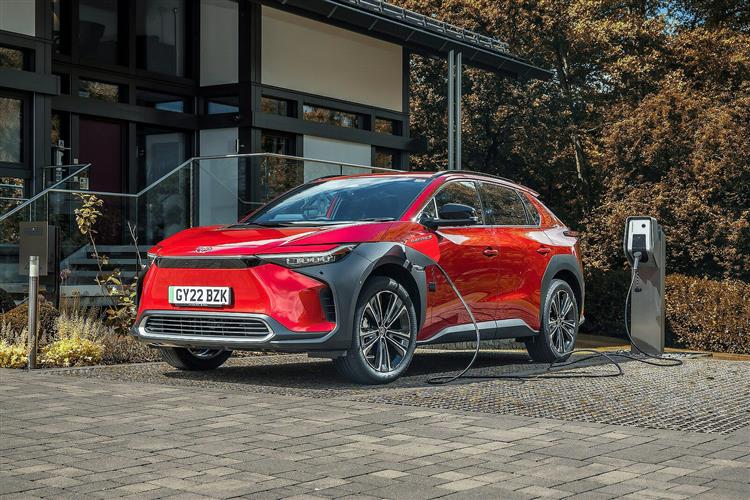
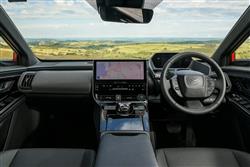
You sense that Toyota was undecided whether it's first proper electric vehicle should look like an EV or an SUV. Which is why we got a design here that blended a bit of both, hardly altered at all from the concept Toyota first showed at the Los Angeles Motor Show in 2021, apparently based around the theme of 'Hi-Tech and Emotion'. At least it's different. And certainly different from Toyota's usual SUV contender of this size, the RAV4. The 4.69-metres-long silhouette's more angular too, with pronounced upper creases on both doors and a lower tick-shaped swage line that flows up into the rear wheel arch. The frontal appearance is characterised by a brand-defining 'hammerhead' shape, with beady signature slim LED headlight 'eyes' and an emphasis on the front corners that's supposed to communicate the car's strong stance. At the rear, the design focus is again on emphasising the corners. The split roof spoiler that's standard above base trim is interesting and its aerodynamic properties are supposed to make unnecessary a rear wiper, so unfortunately Toyota didn't fit one. Inside, it's all quite different, as you'd hope with a car designed from a clean sheet of paper. Whether the bZ4X offers as luxurious a cabin as ought to grace an aspirational upper mid-sized EV is another question. Charismatic furnishing and opulent panelling isn't everything of course and there's no doubt that back in 2021 this was the most sophisticated front-of-cabin design the company had ever offered - and in some ways the most unusual. The absence of a glovebox is supposed to create an airier feeling, which unfortunately you don't really notice because you're hemmed in by the high-set centre console, below which room created by the absence of a transmission tunnel frees up open lower shallow storage space you'll hardly ever use. The other thing you'll notice pretty soon after getting comfortable is the unusual wheel and instrument binnacle arrangement that sees you staring through the spokes of a smaller-than-usual steering wheel at a seven-inch digital combimeter instrument screen supported by unusual grey slatted struts. Anything else you'll need to know will of course be found on the central infotainment monitor, which will be of the 12.3-inch 'Toyota Smart Connect' kind provided you've avoided the base 'Pure' level of trim that hardly anyone will want. That 'Smart Connect' set-up's a vast improvement on previous Toyota infotainment technology and includes over-the-air updates, cloud-based navigation and a decently intuitive voice activation system. The steering wheel and instrument screen layout might take a bit of adjustment, but you'll like the commandingly SUV-like seating position and the supportive front chairs. In the rear, it's certainly spacious in terms of leg room - you'll find it to be vast if you come to this car from a combustion-powered saloon or SUV of this size. Headroom isn't quite so noteworthy, so particularly lanky folk might have to take advantage of the backrest recline adjustment feature. More significant though is an issue that affects quite a few EVs of this kind; namely that the high floor level necessitated by the bulky lower battery pack means that the underside of your thighs could be better supported - though it's something that you'll only notice really keenly on longer trips. Does that long wheelbase translate into a vast boot capacity? Not really. The tailgate's powered providing you avoid base trim and once it rises, a 452-litre capacity is revealed. That seat back recline function means you've the option of making the backrests a little more upright when you're cramming suitcases in - three 82-litre cases would fit if you did that, or if you prefer, a couple of mountain bikes. Toyota forgot to install cargo sidewall catches too, so you've to stretch to the ones on the seat shoulders if you need to flatten the rear bench. Once you've done that, you'll find that the space opened up isn't quite flat, but it should be quite sufficient for the needs of most owners.
To see the full road test text contact us on 0330 0020 227
Pictures (high res disabled)
.jpg)
|
.jpg)
|
.jpg)
| |||
.jpg)
|
.jpg)
|
.jpg)
| |||
.jpg)
|
.jpg)
|
.jpg)
| |||
.jpg)
|
.jpg)
|
|
Scoring (subset of scores)
Category: Hybrid, Plug-in, Electric & Hydrogen
| Performance | |
| Handling | |
| Comfort | |
| Space | |
| Styling, Build, Value, Equipment, Depreciation, Handling, Insurance and Total scores are available with our full data feed. | |