
WHAT'S THE BUZZ? (some text hidden) --NONE--
By Jonathan Crouch
Introductionword count: 53
The Volkswagen ID. Buzz trendily redefined what a large family MPV could be for the new EV era. Practicality is sacrificed on the altar of fashion but hey, this EV's fun but sensible, enviro-conscious but desirable. Which makes it very unusual indeed. Here, we look at the early 2022-2024-era versions of this model.
Modelsword count: 3
5dr MPV (EV)
Historyword count: 322
With this car, the ID. Buzz, one of motoring's most iconic models, the Volkswagen Bus, was finally reinvented. The old Type 2 model it references, in production for a quarter of a century between 1950 and 1975, is still (after the Beetle) Volkswagen's second most recognisable vehicle, variously known as the 'Camper', the 'Bulli' and the 'Hippie van' but most commonly called the 'Microbus' or more usually, just the 'Bus'. Promises from the Wolfsburg maker to recreate it started right back at the turn of the century, first with the 'Microbus concept' of 2001, then with the 'Bulli concept' of 2011, followed by the 'BUDD-e' of 2015 and the 'ID. Buzz Cargo concept' in 2018. The delay was caused because Volkswagen was waiting for the technology to properly reinvent this vehicle for a new electrified era and needed to introduce its ID. series of full-electric hatch models first. This ID. Buzz became the fourth of them at its launch here in 2022, a trend-setting People Carrier that quickly became the Internet's favourite MPV. An astonishing surge of popularity for what had, until then, been a dying market genre. Sold both in this passenger-carrying MPV form and in an alternative commercial 'ID. Buzz Cargo' van guise, it was built in Hanover alongside the brand's more conventional Multivan MPV. Highly fashion conscious, this car followed in the footsteps of trend-setters like modern versions of the Land Rover Defender and the Fiat 500 in looking to re-invent a famous shape for the current age. The early version of this car could only be had in standard wheelbase 77kWh battery 204PS rear motor form. Later in 2024, a comprehensive model update brought a better 286PS/79kWh rear-driven powertrain, the option of a 340PS twin motor 4MOTION GTX flagship model and, most significantly, the option of a second long wheelbase bodyshape that allowed for a third seating row. It's the earlier 2022-2024-era model we look at here though.
What You Getword count: 770
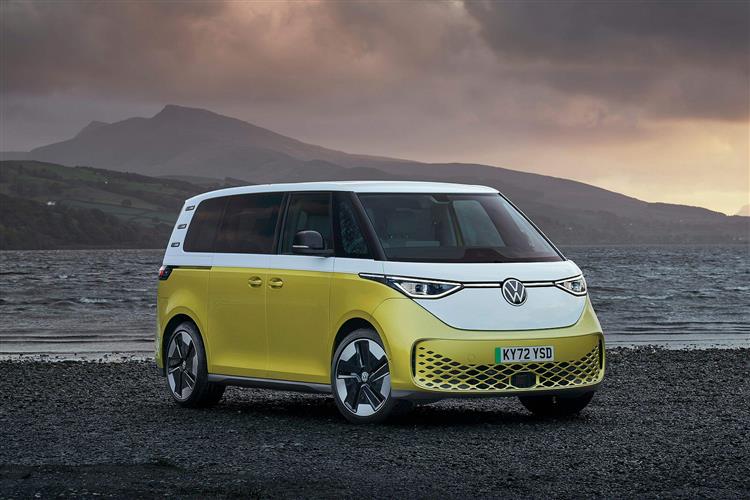
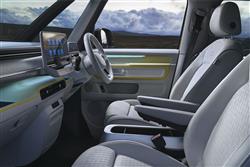
How did Volkswagen manage to make an MPV this appealing? The result is anything but dull to look at, somehow retro, without looking it. It's as much the proportions as the overall style that reflect the classic 'VW Bus' look - at 4.7-metres long in this early model's short wheelbase form, the Buzz is over half a metre longer than the old Type 2 - but there are neat little design touches that help along the way with the retro vibe: a blacked-out glasshouse that creates a 'floating'-style roof; huge aerodynamic flat-faced 19-inch, 20-inch or 21-inch wheels; super-short overhangs; and three gloss black D-pillar streaks, a nod to the rear air vents found on those old classic 'Bus' models. Plus, for a large MPV, there's an outstandingly sleek drag coefficient of just 0.29Cd. And many models were ordered with a Multivan-style two-tone paint finish. It's all distinctly un-van-like, though if you do actually want a van, there's always the ID.Buzz Cargo version. Overall, we think you'll like what you'll find inside up front. You sit much higher than you would in a comparably-priced mid-sized SUV (above all those batteries) and a large, almost upright windscreen allows for lots of light, as does the enormous expanse of glass down each side. Slim A-Pillars and huge front quarter-lights all contribute too. There's a completely open lower floor, so you could walk across and get out of the passenger side, should you feel so inclined. And you can also walk back between the front seats - or at least you could if you removed the central so-called 'Buzz Box', a multi-storage package that easily detaches from its floor clips when you don't need it. The bright, friendly decor of 'Style' spec isn't particularly practical, but helps with the general feeling of spaciousness. And there's a slim illuminating 'ID.Light' panel at the base of the windscreen that'll be a talking point at night. The 'Digital Cockpit' instrument display is the usual compact VW ID screen of just 5.3-inches in size, but it works well; gears are selected via a steering wheel stalk. The much-criticised centre infotainment screen (offered in this early model in either 10 or 12-inch sizes) actually works OK; but the volume and temperature sliders beneath it are awful, as are the switches on the awkward touch-sensitive panel by your right knee. Still the important stuff's properly covered; the seats are excellent and there's a huge amount of cabin storage. Let's consider the rear, accessed, as you'd expect in an MPV, by sliding side doors which as an option, could be electrically-powered. You might want a Buzz fitted with that option because they take quite a slam to manually shut and you don't want have to keep worrying whether the kids have done it properly. Once you're comfortable inside, you wouldn't think this car was based on the same MEB platform as Volkswagen's relatively compact ID.4: there's no lack of occupant space in the back - as you'd hope given the lengthy 2,989mm wheelbase length. What's a little more disappointing is the use of a conventional bench, rather than the three individual seats you'd normally get in a purpose-designed MPV. Still, at least (unlike in most fully electric Crossover models) this bench slides (by up to 150mm), plus the backrest also reclines by quite a long way. This early 2022-2024-era Buzz could only be had in short wheelbase five-seat two-row form. You'll need plenty of rearward space to operate the vast tailgate (tight spaces in multi-storey car parks will be an issue). And with the base variant, original buyers had to pay extra to get it power-operated (which is virtually essential as it's quite heavy). It rises to reveal a low loading sill and a potentially enormous 1,121-litre space, more than twice what you'd get in a comparably priced electric SUV. On the plusher 'Style'-spec model, much of the lower part of that space is taken up with a 'Multi-flex' board, but you can remove that if you wish (and have somewhere to store it). Most of the time of course, you'll leave it in place, which would be convenient because with this suspended floor fitted, the nearer part can be angled up so you can slide the canvas storage trays in and out, one for the safety kit and luggage nets, the other for the charging leads. Should you want to use your ID.Buzz like a removal van, the rear bench backrest can be of course be folded forward. If you do fold the rear bench flat and remove the 'Multi-flex' board, then up to 2,205-litres of space would be available.
To see the full road test text contact us on 0330 0020 227
Pictures (high res disabled)
.jpg)
|
.jpg)
|
.jpg)
| |||
.jpg)
|
.jpg)
|
.jpg)
| |||
.jpg)
|
.jpg)
|
.jpg)
| |||
.jpg)
|
|
Scoring (subset of scores)
Category: Hybrid, Plug-in, Electric & Hydrogen
| Performance | |
| Handling | |
| Comfort | |
| Space | |
| Styling, Build, Value, Equipment, Depreciation, Handling, Insurance and Total scores are available with our full data feed. | |