
EV X-CELLENCE? (some text hidden) --NONE--
By Jonathan Crouch
Introductionword count: 95
Back in 2021 with the launch of the iX, BMW gained a full-electric flagship model of fitting stature in its 'i' range of designs. This was a large luxury SUV aimed directly at the key premium upper mid-sized EV crossover competitors of the day - cars like the Audi e-tron, the Jaguar I-PACE and the Mercedes EQC. It aimed to showcase everything the company knew about Zero Emissions motoring. As it turns out, that was quite a lot. Here, we look at the earlier versions of this first generation iX from a used buyer's perspective.
Modelsword count: 7
5dr SUV (EV) [Sport, M Sport, M60]
Historyword count: 425
By 2021, BMW's all-electric model line-up, for years solely carried by the little i3, was at last taking shape. By then, we'd already been introduced to the i4 sports saloon and the iX3 mid-sized SUV. And beyond that, there was this car, the iX, a large luxury SUV which the Munich maker hoped would move the game on from the standards that had already been set in this segment by direct rivals like the Audi e-tron, the Jaguar I-PACE and the Mercedes EQC. If you're in the market for a used EV of this size from the 2021-2024 era, you'll probably already be fairly familiar with the three competitor cars just mentioned. And why wouldn't you be? They were launched around three years before this iX hit the market in mid-2021. So BMW was well behind the game here - which was incredible given that the Munich maker was well ahead of EV technology when they launched the i3 back in 2013. Eight years on, you could sense the brand's desperation to get back on track in almost every aspect of this iX - to cause a sensation, to create talking points and to shift people's perceptions towards BMW as a primary purveyor of industry-leading luxury EVs. That was an immense weight of expectation to put on any car, particularly one that actually wasn't quite as sophisticated as it might have first appeared. The lack of a number in the model name was supposed to designate this model's positioning as the flagship of BMW's i sub-brand and, sure enough back in 2021, the company claimed the iX to represent the pinnacle of its electrification strategy. It was certainly the brand's first 4WD EV, it used the fifth generation of the Bavarian maker's e-motor and battery technology and the carbonfibre-rich structure was more innovative than anything we'd seen from the company since the i3. But there was still plenty of conventional design from combustion models in the 'CLAR'-influenced platform. And there was no sign here of the advanced 800-volt fast-charging infrastructure that you'll find on top VW Group EVs from this era. Despite all that, you'll certainly feel that you've got an advanced luxury EV if you own one of these - when you look at it in your driveway or slip inside the futuristic cabin. A top M60 xDrive flagship model was added in 2022. The iX sold in its original form until BMW introduced a far-reaching update for the 2025 model year. It's the earlier 2021-2024-era versions of this model we look at here.
What You Getword count: 706
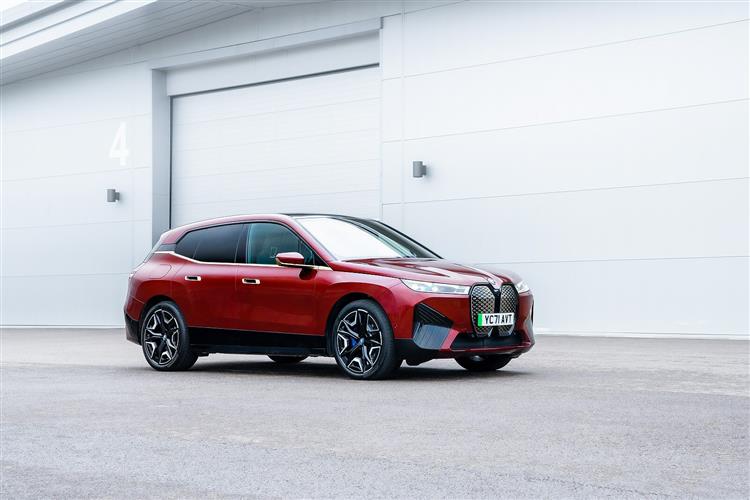
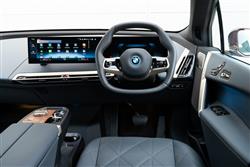
By and large, BMW doesn't do 'beautiful', but it is very much a specialist in 'striking' - and this iX is certainly that. It's certainly big, just under 5-metres long, around 2-metres wide and a fraction under 1.7-metres high - about the same size, in other words, as the company's X5, which BMW claims shares nothing with this car. Like the old i3, there are carbonfibre cores for the windscreen pillars and cant rails - and aluminium honeycomb door sills too, plus in this case carbonfibre-reinforced plastic for the roof, all of it intended to allow this car to tip the scales somewhere near the class norm point of around 2.2-tonnes. Inevitably though, the iX gets nowhere near that benchmark; think nearly 2.6-tonnes, 650kgs of which is accounted for by the lithium-ion battery pack. One day, historians will be shocked that EVs were ever like this. Shock is exactly what unsuspecting fast lane dawdlers will feel when they suddenly find this car's huge kidney grille bearing down upon them at warp speed. And in profile? Well the shape may appear a touch ungainly but it's undeniably aerodynamic, with a sleek drag co-efficient of just 0.25Cd. There's a wraparound look to the tailgate, with thin horizontal rear LED lamps stretching towards the central BMW roundel in an unnecessary attempt to emphasise this car's prodigious width. According to its maker, this car was designed 'from the inside out', the focus being on what the Bavarian brand calls its 'Lighthouse' interior. It certainly light, especially with the optional dimmable Sky Lounge panoramic roof fitted. There's so much to take in. The curious hexagon-shaped steering wheel is difficult to ignore; your main point of control is a rocker switch for gear selection; and even in a screen-dominated era, the 'Live Cockpit Professional' set-up's gently curving slither-like joined 'Curved Display' is unusual, apparently floating above the angular dash and incorporating a 12.3-inch instrument set-up and a 14.9-inch central infotainment screen. Strange trimming combinations assault the eyes, there's a button rather than a handle to open the door and you sit almost Range Rover-high, though here of course the raised floor is there for quite a different reason, the unusual quilted leather seats with their plant-based upholstery and integral head restraints set upon it. The two-part centre console's a bit different, designed, BMW says, in the style of 'a high quality piece of furniture' and free-standing, so there's a lovely open footwell right across the front of the car. Despite the fact that there's over 3 metres between the axles in an iX, BMW elected not to make this a seven-seater, so if you're shopping for a car of this sort from this era, you'll need to choose a Tesla Model X in this class if that's what you need. Still, that decision ought to benefit back seat room and sure enough, it feels properly spacious in the back, aided by the rear quarterlight windows and the kind of completely flat floor that you'd have to do without in rival Porsche Taycan or Audi e-tron GT models, where the centre transmission tunnel, banished here, is excessively high. Because the floor isn't inset with little so-called 'foot garages' - the insets into the lower EV floorplan that you'd get with the rival VW Group luxury EVs just mentioned - your feet are positioned a little higher, but there's plenty of knee space and, unlike with some rivals, original owners of this early model didn't have to pay extra for rear seat climate controls, which sit beneath the twin central vents. Given nearly 5-metres of body length, you'd hope for plenty of luggage capacity here. Actually, the powered tailgate with its two-piece parcel shelf rises to reveal a 500-litre space: not bad, might be your initial thought, until you check rival stats and realise that this is pretty much the same as you'd get from a Jaguar I-PACE or a Mercedes EQC from this era - and they're both significantly smaller SUVs. If you need more space, then activating the cargo sidewall catches flattens the main part of the rear bench - there are also little buttons just inside the rear doors that do the same thing. And that frees up 1,750-litres of space.
To see the full road test text contact us on 0330 0020 227
Pictures (high res disabled)
.jpg)
|
.jpg)
|
.jpg)
| |||
.jpg)
|
.jpg)
|
.jpg)
| |||
.jpg)
|
.jpg)
|
.jpg)
| |||
|
Scoring (subset of scores)
Category: Hybrid, Plug-in, Electric & Hydrogen
| Performance | |
| Handling | |
| Comfort | |
| Space | |
| Styling, Build, Value, Equipment, Depreciation, Handling, Insurance and Total scores are available with our full data feed. | |