
FLAWED BUT DESIRABLE (some text hidden) --NONE--
By Jonathan Crouch
Introductionword count: 64
Electric cars are all very worthy but, by and large, they tend to lack any kind of 'want one' factor. Here's one though, that you might really covet - the Honda e, sold between 2020 and 2024. Because it's very small and doesn't go particularly far on a single charge, it's very much an urban town runabout. But what a cool one to have.
Modelsword count: 7
5-door Hatch EV [standard, Advance, Special Edition]
Historyword count: 349
What should a city-based full-electric urban runabout really be if an element of desirability as well as efficiency is called for? Something like the Honda e? We can see why you might think so. Back in 2020 it was arguably the cleverest, most innovative Honda we'd seen in decades. First a bit of background. Prior to 2020 Honda had been dabbling with EV technology since the late Eighties and was actually an early leader in electric vehicle tech. Its EV Plus model back in 1997, for instance, was the first commercially available electric car to break away from old-fashioned lead/acid battery packs. In the early years of this century though, the company's engineers changed direction, (rightly) deciding that hydrogen fuel cell powertrains were a more sensible long-term solution. When a public hydrogen refuelling infrastructure failed to materialise though, Honda was forced back to the EV drawing board but by then, the game had moved on and the company was playing catch up. It took until 2017 for things to get back on track - with two concept cars, the 'Urban EV' and the 'Sports EV', both directly influencing the final production version of the futuristic-looking Honda e production model. It wasn't only the looks here that broke the mould of compact EV design. Wanting the car to be small and quick-to-charge in keeping with its urban remit, Honda ensured that its powertrain battery was also small (35.5kWh), which meant quite a meagre WLTP-rated driving range - at best, just 125 miles. Honda was unrepentant, pointing out that the average British driver's commute was only about a fifth of that, an argument also championed by the marketing behind two directly comparable (and similarly priced) rival models of this period, the MINI Electric and the Mazda MX-30. Those cars compensated range anxiety with fashionable design - but not to quite the same extent as this one did. A base-spec 136PS variant was offered until 2022 to sell alongside the 154PS 'Advance' version. And a special edition variant offered from 2022 to 2023. The Honda e vanished from the market in 2024.
What You Getword count: 856
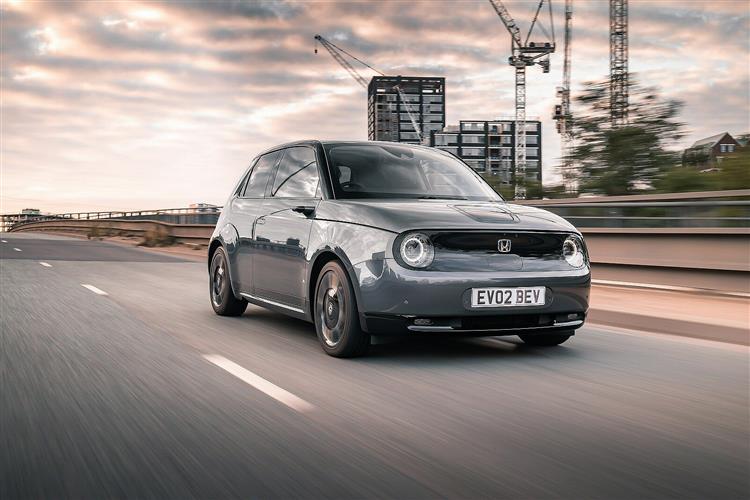
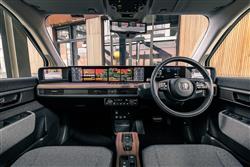
Rarely have we ever come across a car that looks quite so much like a motor show concept. Not everyone will like the look of this Honda e, but there's certainly nothing like it on the road. Where to start? With the bonnet perhaps, it being there, rather than in the front or rear wing, that the charging flap is located, beneath a classy glass cover that conceals the smartly illuminated sockets. Above it, the panoramic windscreen blends into the A-pillars and the side windows, but your attention will be rather more taken with what lies below. Black panels with unique concave profiles are one of the car's defining style motifs, particularly at the front end, where this feature is flanked by cute circular front headlights that Designer Ken Sahara said helped define the 'human face' of the car, emphasising its simple, clean design. The shaping is one of two things that pay homage to the model with which Honda pioneered its presence in the small car segment, the 1972-era Civic. The other is the gently scalloped detail line that runs across the flank and up the C-pillar, framing the glasshouse and adding a sense of depth to the smooth surfacing. Ah yes: smooth surfaces. They're another styling theme here, with almost nothing allowed to spoil the clean flush finishing. Not front door handles (which only retract proud of the panel work as you approach the car); not roof edge rain gutters (the aerodynamics don't require them); you don't even get door mirrors, these replaced by a clever 'Side Mirror Camera System' working via tiny lenses housed in little brackets attached where those mirrors would normally be, which eliminate the need for channel lines to divert air flow and rain water away from the side of the car. The stuff you can't see deserves equal recognition. You'd expect simply a re-packaged version of the front-driven chassis that underpined this car's Jazz Hybrid showroom stablemate in this period. Instead, the Honda e was based on a completely different steel platform that broke with small EV convention by siting the electric motor at the back where, unusually for a compact battery-powered model, it drove the rear wheels. More conventionally, the power electronics and on-board charger sit at the front and the lithium-ion battery pack sits beneath the cabin floor, the main determinant in creating a portly kerb weight of at least 1,513kgs. And if you thought there was lots to talk about outside, wait until you take a seat in the cabin. Inside, you're greeted by an interior that'll be unlike anything you've ever sat in. Designed under stylist Akinori Myoui, it's open-plan and avant garde, with soft, flat seats that perch you quite high and are upholstered in the kind of fabric that you might find on a chic high-end sofa. Most eye-catching though, is the way that the full-width digital dashboard incorporates more screens than you'd find in a computer hacker's bedroom, there being no fewer than five of them. The instrument binnacle has one of course - a rather cluttered 8.8-inch monitor replacing conventional dials. And at either end of the dash lie 6-inch monitors relaying images from the 'SMCS' 'Side Mirror Camera System we mentioned earlier. In between are two 12.3-inch oblong infotainment displays joined at the centre of the fascia, with features you can switch between monitors that can deliver way more than the usual infotainment features and can play movies, accept gaming console attachment and even show a calming Aquarium. We think you're less likely to appreciate the light artificial wood inlays, which seem an odd trimming choice in such a futuristic car. But at least everything's light and airy, the generous wheelbase facilitating far more interior space than you'd ever think would be possible from the diminutive exterior dimensions, that ambience embellished by light materials, big windows, a standard-fit sunroof and the deletion of the usual transmission tunnel which creates a large flat area between the front footwells. What about the rear? Can it really replicate the relatively spacious feel delivered up-front? To some extent, yes. The sofa-like seating actually looks like a sofa here - though not a particularly inviting one. More the kind of thing you'd find in a student's loft apartment. Because of the battery pack beneath the floor, this bench can't do anything clever like it can in this model's Jazz showroom stablemate, where the base lifts up cinema seat-style. It's also disappointing that you can only seat two in the back - particularly as the virtual absence of a centre transmission tunnel means that space for a third person would be possible at a pinch, had a belt been provided for them. Finally, let's consider the boot. OK, so you can't expect too much in terms of boot space from a car just 3.9-metres in length, but you might hope for a bit more than 171-litres. With everything folded, 861-litres of capacity is on offer if you load to the roof or 571-litres if you load to the window line, these figures about a third less is offered by than the Jazz model we just mentioned.
To see the full road test text contact us on 0330 0020 227
Pictures (high res disabled)
.jpg)
|
.jpg)
|
.jpg)
| |||
.jpg)
|
.jpg)
|
.jpg)
| |||
.jpg)
|
.jpg)
|
.jpg)
| |||
.jpg)
|
|
Scoring (subset of scores)
Category: Hybrid, Plug-in, Electric & Hydrogen
| Performance | |
| Handling | |
| Comfort | |
| Space | |
| Styling, Build, Value, Equipment, Depreciation, Handling, Insurance and Total scores are available with our full data feed. | |