
SMARTER PACE MAKER (some text hidden) --NONE--
By Jonathan Crouch
Introductionword count: 105
Jaguar's F-PACE always brought a well-judged compromise of class, performance and capability to the luxury mid-sized SUV segment. If you're looking for one, try to stretch to the 2020-on facelift version we look at here. With this updated model, buyers were offered mild hybrid engine electrification, plus a Plug-in model. Along with more sophisticated media connectivity and a far smarter cabin. In this form, this Jaguar finally became the car it always should have been and if you're shopping in the segment for mid-sized premium badged SUVs in the 2020-2024 era, it offers a refreshing, arguably more dynamic and very Jaguar-like alternative to key rivals.
Modelsword count: 8
5dr SUV (2.0, 3.0 Diesel, 3.0, 5.0 Petrol)
Historyword count: 440
If there's one type of car that epitomises the early part of this century, it's the SUV. So many buyers desire them and by this century's second decade, Jaguar had at last decided that it wanted a slice of this action. As a result, back in 2015, the British company brought us its first ever model of this kind, the F-PACE, complete with high-riding driving position, four-wheel drive and even some moderate off-road ability. Five years on, it was updated to create the car we're going to look at here. Why it took Jaguar so long to enter a segment that had been dominating luxury car sales since the turn of the century is a difficult question to answer. There was never the investment to create such a thing until Indian conglomerate TATA took over control 2008. And afterwards, given Jaguar's close partnership with Land Rover, there was a management disinclination for the two marques to cross into each other's territory. But it was thinking that had to change. At the same time, around the time of this model's original launch, Jaguar's engineers were grappling with the challenge of all-electric engineering, eventually responded to with another similarly-sized SUV, the battery-powered I-PACE launched in 2018, which went on to become one of the company's best selling models. Safe in the knowledge that mixing the SUV genre with electrification would hit the sales sweet spot, Jaguar then combined the two in late 2020 to create the hugely improved F-PACE model we're considering here. Obviously the existence of the I-PACE meant that there was no need for a full-battery EV version of this car - the F-PACE's sophisticated aluminium chassis didn't allow for that anyway. But by 2020 you could have a PHEV plug-in hybrid variant - the P400e derivative - with an EV range of 33 miles. The more affordable diesel combustion variants that most F-PACE customers continued to choose got a lesser sprinkling of electrification courtesy of an MHEV mild hybrid system. And, for those who really didn't care about the polar ice cap and only prioritised performance in an SUV of this type, the wild V8 petrol-powered SVR model continued on at the top of the range. Away from engines, the cabin was completely redesigned around a cutting-edge 'Pivi Pro' infotainment system. There was also a smarter exterior look and sophisticated safety. In this form, the F-PACE continued to sell steadily against tough rivals also refreshed at about the same time, cars like the Audi Q5, the Mercedes GLC and the BMW X3. The F-PACE was discontinued when Jaguar pulled out of the UK market at the end of 2024.
What You Getword count: 486
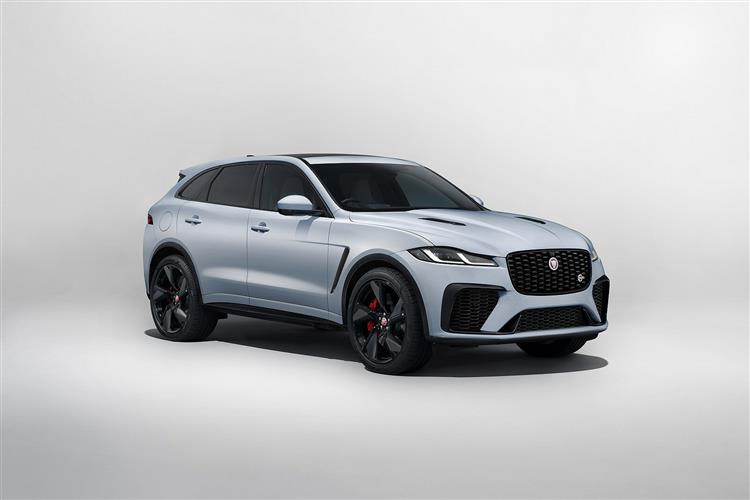
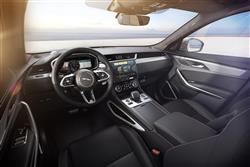
It says much that Jaguar liked to market this F-PACE as the 'sportscar of SUVs'. Not much changed with this package of exterior updates. Or at least you might think that, until you take a closer look. There's a more sculpted bonnet with a wider power bulge, that bonnet extending flush to the very top of the grille surround, eliminating the rather ugly shut line that previously ran across the nose. It flows into a larger, completely redesigned heritage-inspired monogrammed mesh grille with diamond detailing and the classic Jaguar 'Growler' badge. There are fewer changes in profile, though the side vents gained the iconic Jaguar Leaper. At the rear, the tail lights of this updated model, originally inspired by the F-TYPE sports car, have more in common with the I-PACE EV, featuring Jaguar's 'chicane' illuminating graphic. Of course, as usual, what's more important is the stuff you can't see. Around 80% of the body is fashioned from lightweight aluminium and some of it - the cross chassis rail for example - even uses hi-tech magnesium. Unusually for a mid-term facelift, almost everything inside at the wheel was fundamentally redesigned - and was all the better for it. The focal point is the much more sophisticated 11.4-inch curved 'Pivi Pro' central touchscreen, but there's also much else to catch the eye in an interior that feels very Jaguar, with an ambiance completely different to that you'll find in German rivals. There's lots to take in if you happen to be used to the original model - things like the sleeker vents, the dished 3-spoke wheel and the more tactile gear lever replacing the rising rotary dial used before. Surrounding it all, authentic finishes feature in beautifully formed shapes reinvigorating Jaguar's rich lineage of luxury interiors. Upper-spec models also get a 12.3-inch configurable instrument screen and you'll like the wider cushioned leather-trimmed seats. Storage space was much improved thanks to a lower centre console, redesigned with a sliding section at the top and an open lower aperture at the bottom. And lovely touches were plentiful; the lovely cool zinc alloy gear shift paddles; the 'cricket ball'-style stitching on the gear lever; the split-rim steering wheel; and, if you get a car whose original owner opted for the Meridian audio system upgrade, lovely brushed-metal laser-etched lacquered silver speaker frets. Once installed in the rear, two tall adults get more headroom than you might expect the raked-back roofline to be able to provide and there's reasonable standards of knee room too. Out back, the powered tailgate rises to reveal one of the larger luggage compartments in the mid-sized SUV segment, the dry load space capacity for mainstream models rated at 601-litres, enough for up to eight carry-on suitcases. That's unless you opt for the P400e Plug-in Hybrid variant. With that, thanks to the battery pack which must lie beneath the base of the cargo area, dry capacity falls to 485-litres.
To see the full road test text contact us on 0330 0020 227
Pictures (high res disabled)
.jpg)
|
.jpg)
|
.jpg)
| |||
.jpg)
|
.jpg)
|
|
Scoring (subset of scores)
Category: Crossover or SUV 4x4s
| Performance | |
| Handling | |
| Comfort | |
| Space | |
| Styling, Build, Value, Equipment, Depreciation, Handling, Insurance and Total scores are available with our full data feed. | |