
FRONT LOADED (some text hidden) SECTIONED_new_vauxhallfrontera_2025
By Jonathan Crouch
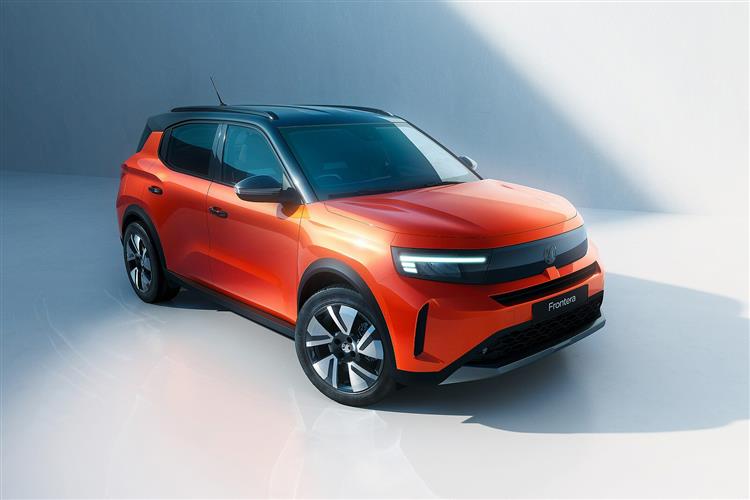
Vauxhall hopes this new kind of Frontera SUV will appeal to small families. Jonathan Crouch drives it.
Ten Second Reviewword count: 57
Vauxhall reinvents its Frontera for a new era - with a little help from Citroen. There's plenty of powertrain electrification, potential seating for up to seven and quite a lot more attitude than any previous Vauxhall SUV. If you've never considered one of the brand's small crossovers before, there's just a chance you might like this one.
Backgroundword count: 174
So: Vauxhall's new era Frontera. There's lots to get used to here. First the fact that it's replacing the brand's previous entry-level SUV (the Crossland) but isn't the brand's smallest SUV (size-wise, the Frontera slots in between the Mokka and the Grandland). Second, this is the first Vauxhall SUV with the potential for up to seven seats. And third, there's the curiosity that the Griffin brand would want to bring back the name of a turn-of-the-century model it sold that had possibly the worst build quality and reliability of any SUV made in that period. But of course Vauxhalls are very different now, always sharing the engineering of models from fellow Stellantis Group brands, in this case primarily Citroen and Fiat. The Frontera is based primarily on the second generation Citroen C3 Aircross, which means that as well as that third seating row option, it can offer the choice of either Hybrid or EV drivetrains. It's certainly a much more practical family wagon than the old Crossland. And a very different kind of Frontera.
Driving Experienceword count: 409
The Vauxhall / Opel engineers designed the Frontera primarily around an EV drivetrain, so that's what we chose to try. Unlike with Stellantis battery-powered models built on the fractionally larger EMP2 platform (like Vauxhall's Mokka Electric), this set-up doesn't come with selectable drive modes - there isn't even an 'Eco' button, which will be a relief if, like us, this is the sort of thing you're always forgetting to engage on EVs. There aren't any brake regen settings either - except a rather counter-intuitive one; this 'C' (for 'Comfort') setting on the gear selector. Curiously, this provides less brake regen (0.8m/s) rather than more (ordinary 'D' gives you 1.2m/s). The electric drivetrain comes in two flavours. We tried it with the base 44kWh battery, a rather small package of cells for a lower-order compact family car which, predictably, returns a very modest range figure of 190 miles that we got nowhere near during our time with this car. If that's a problem and you still want a Frontera Electric, then you'll have to find quite a slug more for a version with the larger 54kWh battery, which boosts range up to a more usable 248 miles between charges. Both variants use the same 113PS front-mounted motor, which you might hope in a relatively light little EV would make performance feel quite sprightly, even though pulling power is limited to a modest 124Nm. It doesn't. There are two alternative combustion drivetrains; either a base unelectrified 1.2-litre three cylinder petrol unit with 100PS and 205Nm of torque which makes 62mph in 12.4s (in five-seat form). But you're more likely to want the Hybrid. This is actually technically a mild hybrid, but this Stellantis-sourced unit can do quite a lot of things a full-Hybrid drivetrain would be able to do - like function on battery power alone for low-speed manoeuvring; in fact, Vauxhall claims up to 50% of urban driving could theoretically be done without troubling the 1.2-litre three cylinder petrol turbo engine, which is paired with a 28hp 48V motor built into a clever 6-speed dual clutch e-DCT6 auto gearbox. There's now just a single version of this unit offering 145PS with 230Nm of torque; it makes 62mph in 9s and maxes out at 118mph. So the performance of a Hybrid Frontera can be quite different from an Electric one. Unfortunately, the same can be said of ride quality, which is noticeably firmer and more fidgety and unsettled with the Hybrid
To see the full road test text contact us on 0330 0020 227
Pictures (high res disabled)
.jpg)
|
.jpg)
|
.jpg)
| |||
.jpg)
|
.jpg)
|
.jpg)
| |||
|
Statistics (subset of data only)
Min |
Max |
|
Price: |
£22,820.00 (At 12 Oct 2026, 1.2 petrol) |
£29,930.00 (At 12 Oct 2026, Hybrid 145 PS Ultimate) |
CO2 (g/km): |
135 (1.2 petrol) |
119 (Hybrid) |
Max Speed (mph): |
87 (Electric 113PS) |
118 (Hybrid) |
0-62 mph (s): |
12.4 (1.2 petrol) |
9 (Hybrid) |
Electric WLTP-Rated Driving Range (miles): |
186 |
|
Combined Mpg: |
47.1 (1.2 petrol) |
53.3 (Hybrid) |
Length (mm): |
4385 |
|
Width (mm): |
1795 |
|
Height (mm): |
1655 |
|
... and 3 other stats available | ||
Scoring (subset of scores)
Category: Crossover or SUV 4x4s
| Performance | |
| Handling | |
| Comfort | |
| Space | |
| Styling, Build, Value, Equipment, Depreciation, Handling, Insurance and Total scores are available with our full data feed. | |